
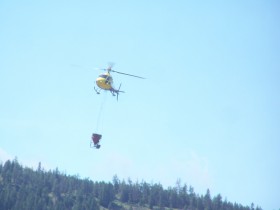
Working helicopters are still above. In most instances they are away from public however some waterways are used by them. They need a wide space to fill buckets and get back to altitude.
Click for playlist…
File Photo KDG
Air attack is an industry term used for the actual application of aerial resources, both fixed-wing and rotorcraft, on a fire. Within the industry, though, “air attack” may also refer to the supervisor in the air (usually in a fixed-wing aircraft) who supervises the process of attacking the wildfire from the air, including fixed-wing airtankers, helicopters, and any other aviation resources assigned to the fire. The Air Tactical Group Supervisor (ATGS), often called “air attack”, is usually flying at an altitude above other resources assigned to the fire, often in a fixed-wing plane but occasionally (depending on assigned resources or the availability of qualified personnel) in a helicopter.
Depending on the size, location, and assessed potential of the wildfire, the “air attack” or ATGS person may be charged with initial attack (the first response of firefighting assets on fire suppression), or with extended attack, the ongoing response to and management of a major wildfire requiring additional resources including engines, ground crews, and other aviation personnel and aircraft needed to control the fire and establish control lines or firelines ahead of the wildfire.[
On this Day: August 3rd 1997
Sky Tower opens in Auckland New Zealand.



 Kevin Griffiths
 percypaschal
 The Proprietor Review