You are presumed to be honest and responsible without evidence to the contrary beyond a reasonable doubt… on the balance of probablilties you are justified by 51 % likelyhood.
So there’s been a color paste around the valley. Some of the green is gone and now it’s Autumn for sure.
The chemical signal went down through the trees from the leaves, turning off the carbon dioxide to the leaves, and is now going into the trunk and being turned into sugars to be preserved over the winter.
Who’s bigger now? Valcanos or hydrocarbon fuel burns by rockets and Jet craft.
In the complex creation of the Earth numbers of periods that went on for millions of years to create our atmosphere, luck or good grace, it happened that we had a nice bounce, oxygen, nitrogen and small amounts of various other elements for us to breathe.
If you want to get you a perspective, try some red peppers that are very hot and then wait for the hiccups. Water won’t help because of the interaction of the two elements. Milk or ice cream might help it helped me when I did it. But you’ll get hiccups and burning just from the interaction of two compounded chemicals that could take 1 or 3 weeks to clear. How much more is our atmosphere sensitive?
Not saying we shouldn’t but Musks rational of making the solar system more than a one planet habited by humans to save us, a reality in a self-fulfilling prophecy.
Eden a charm…
Watch this Letterman interview with Elon when his first Roadster was offered at a range of 244 miles per charge. Offered at 100 thousand dollars.
The Guardian reported this model to have a system air purification to protect from a “Biological Attack”
Global consumption of jet fuel:
hovers around 250 to 280 million metric tons (roughly 90 to 100 billion gallons) per year.Regional Breakdown: Canada, Europe, and AsiaAviation fuel consumption is heavily dictated by population, economic activity, and major international transit hubs.
* Canada: *
Canada consumes roughly 150,000 to 165,000 barrels per day (approximately 8.5 to 9 million metric tons annually). While domestic travel spans vast distances, Canada’s overall volume is lower than massive global transit corridors due to a smaller total population.
* Europe:
* Europe as a collective block is one of the world’s largest aviation markets. Major economies like the UK, Germany, Spain, France, and Italy each consume between 100,000 and 260,000 barrels per day individually. Combined, European nations account for roughly 20% to 25% of global jet fuel consumption, driven by dense intra-continental networks and massive international hubs (like London Heathrow, Frankfurt, and Paris Charles de Gaulle).
* Asia:
* Asia is the fastest-growing and largest regional consumer of jet fuel, spearheaded by China (the world’s second-largest consumer behind the US, burning over 750,000 barrels per day), along with heavy consumption from Japan, India, South Korea, and Southeast Asian transit hubs like Singapore. Asia collectively accounts for roughly 30% to 35% of global jet fuel demand and is scaling up rapidly.Effects on the AtmosphereAviation accounts for roughly 2% of global human-induced \text{CO}_2 emissions, but its total impact on global warming is estimated to be two to three times greater (roughly 3% to 5% of total climate warming) because of non-\text{CO}_2 high-altitude emissions.
The atmospheric effects break down into several distinct mechanisms:
* Carbon Dioxide (\text{CO}_2) Emissions:
* Burning jet fuel releases massive amounts of \text{CO}_2 directly into the atmosphere (roughly 3.16 kg of \text{CO}_2 per 1 kg of fuel burned). Because \text{CO}_2 is a long-lived greenhouse gas, this contribution persists for centuries, trapping heat uniformly across the globe regardless of the altitude at which it was released. * Contrails and Cirrus Clouds
(The Albedo Effect):
* At high cruising altitudes (usually above 30,000 feet), hot engine exhaust interacts with cold, humid air to form condensation trails (contrails). These trails can spread out into persistent artificial cirrus clouds. * These clouds trap outgoing longwave radiation from the Earth, creating a net warming effect. Nighttime flights have an even stronger warming impact because they trap heat without any offsetting daytime sunlight reflection.
* Nitrogen Oxides (\text{NO}_x) and Ozone:
* Jet engines emit \text{NO}_x, which reacts in the upper troposphere and lower stratosphere to form ozone (\text{O}_3), a powerful greenhouse gas at those altitudes. Conversely, these reactions also destroy some ambient methane, but the net result is a short-to-medium-term warming effect.
* Soot and Water Vapor:
* Soot particles and water vapor emitted directly into the upper atmosphere act as seeds for ice crystal formation, further driving cloud-formation processes that alter the Earth’s radiative balance.
Editors note:
Do a carbon trade off, take a train if you can, electric, hydro generated if possible.
Across generations, family members—and men in particular—often face similar causes or patterns of mortality due to shared genetic predispositions and passed-down inherited health conditions. Complex non-communicable diseases like cardiovascular disease, specific cancers, and metabolic disorders frequently run in paternal or familial lines, increasing baseline risk. Beyond biology, families share behavioral patterns, dietary habits, occupational exposures, and lifestyle choices that are passed down through environment and cultural modeling. Men within the same family historically often engaged in similar hazardous occupations, trade environments, or physical activities that exposed them to identical industrial hazards or injury risks over time. Additionally, socio-economic factors and systemic health disparities tend to persist across generations, influencing a family’s long-term access to healthcare, living conditions, and quality of life. Together, these intersecting genetic, environmental, behavioral, and socio-economic threads create distinct, recurring mortality patterns within family lines without any reliance on supernatural causes.
Editor’s note: A reminder to be safe, not legal advice…
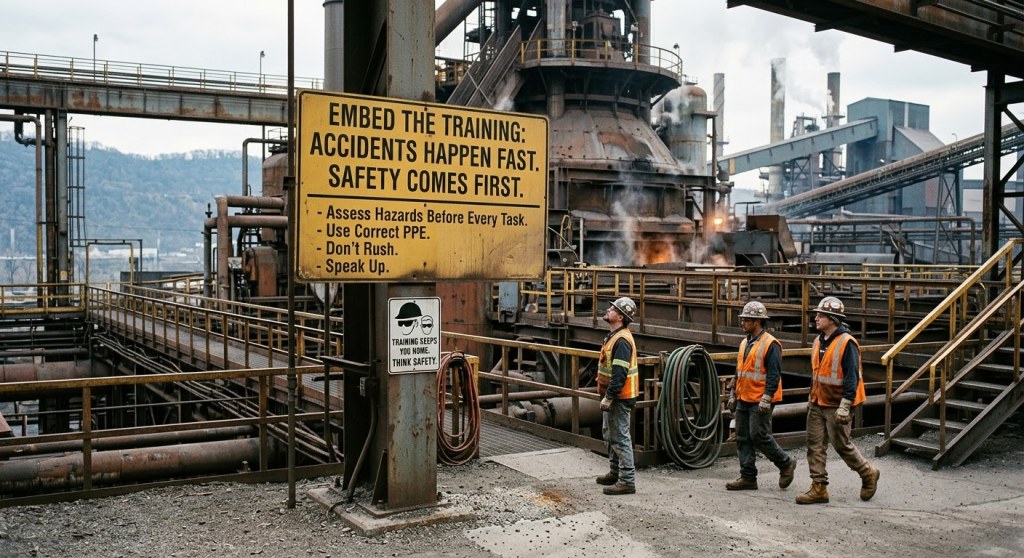
Safety and training are inseparable in industrial operations; training converts theoretical safety protocols into second-nature workplace habits. Effective safety programs rely on rigorous, continuous training to help workers recognize hazards, operate heavy machinery correctly, and execute emergency procedures under pressure. Conversely, safety measures only succeed when workforce training ensures every employee understands the “why” behind the rules, transforming compliance from a checklist into an active, shared culture that minimizes risk and prevents costly accidents on the floor.
Editor’s view..
Most everybody knows somebody that may have gotten hurt in an industrial situation or any situation for that matter. The injury is terrible.
Recovering everything is probably not possible, avoid it like a plaque.
The paths taken by two 20-year-old veterans illustrate the contrast in outcomes at this level:
1. The Collegiate / Minor-Pro Bound Veteran * Player Profile: Brady Magarrell (Forward, Beaver Valley Nitehawks) *
The Trajectory: Highly productive 20-year-old top scorers and league MVPs routinely leveraged their dominant final season to secure spots at the next level. Players like Magarrell—who put up over 70 points in a 44-game regular season—showcase elite hockey IQ, leadership, and readiness for physical play. * Next Chapter: Players on this tier typically commit to U Sports programs (like Simon Fraser University or the University of Victoria) or high-level ACAC / ACHA Division 1 college teams. A select few use their momentum to land contracts or tryouts with lower-tier European professional clubs or North American minor-pro leagues (such as the SPHL).
2. The Career Transition / University Student * Player Profile: Logan McCabe (Defenseman, Grand Forks Border Bruins)
* The Trajectory: Solid, dependable 20-year-old core veterans—often blue-liners or depth leaders—play a crucial stabilizing role for their junior clubs while nearing the end of their competitive hockey arcs. After anchoring a defense and taking significant penalty minutes over a multi-year junior career, the 20-year-old season serves as a ideal closing chapter. * Next Chapter: Players in this group typically “hang up their competitive skates” after their final game. They transition directly into full-time post-secondary education (entering university or trade apprenticeships) using league education scholarship funds. While they step away from Junior A, many continue to play casually in competitive Senior A circuits or local adult leagues while building their post-hockey careers.
Numbers
Across the 22 teams in the British Columbia Hockey Conference (BCHC) Junior A league, roster limits strictly regulate the number of 20-year-olds (referred to as “age-outs”) to ensure opportunities remain open for younger developmental players.Below is the approximate breakdown of how many 20-year-olds complete their junior eligibility each year and where they transition afterward:1. How Many 20-Year-Olds Complete Their Junior Careers? * Roster Caps: BCHC rules generally limit each team to carrying a maximum of 6 to 8 twenty-year-olds on an active roster. * Total Players: Across 22 member teams, that means roughly 130 to 175 twenty-year-olds complete their final season of junior eligibility each spring across the league.
2. How Many Move On to Play Higher-Level Hockey?
Out of those ~150 aging-out players, approximately 25% to 35% (about 35 to 55 players) continue playing competitive organized hockey: * U Sports & Canadian Colleges (~15–25 players): The primary pathway for top BCHC age-outs is Canadian post-secondary hockey—such as USports programs (e.g., SFU, UBC, or Prairie schools), ACAC (Alberta Colleges Athletic Conference), or BCIHL (BC Intercollegiate Hockey League). * NCAA Division III & ACHA (~10–20 players): Some players secure commitments to American college programs in NCAA D-III or high-level ACHA Division 1 club programs. * Minor Pro & Overseas (~5–10 players): A small handful of standout veterans earn professional tryouts or contracts in North American minor-pro leagues (SPHL, FPHL) or lower-tier European leagues (Germany, Sweden, UK).
3. How Many “Hang Up Their Skates”?Roughly 65% to 75% (about 90 to 120 players) transition away from competitive, full-time hockey after their 20-year-old season. * Transition to University/Trades: Most leverage their junior hockey background, discipline, and league education funds to pursue full-time degrees or skilled trade apprenticeships. * Senior A & Recreational Leagues: Many do not stop playing hockey entirely—they transition into high-caliber Senior A leagues (like the CIHL in BC) or competitive local adult leagues while starting their post-hockey careers.
Overview of the British Columbia Hockey Conference (BCHC) Junior A Pathway:
* Leagues Involved: The BCHC itself operates as 1 unified Junior A league. It was formed through the restructuring of former Tier 2/Junior B circuits (the KIJHL and PJHL) into a consolidated BC Hockey-sanctioned Junior A circuit. * Number of Teams: There are 22 member teams competing in the inaugural 2026–27 BCHC season, split across four geographical divisions (Interior, Kootenay, Mainland, and Valley). * Number of Players: Junior hockey rosters typically carry between 20 to 25 players per team at any given time. Across the 22 teams in the league, that accounts for approximately 440 to 550 active rostered players total. * Games per Team: Each team will play a 50-game regular season schedule (25 home games and 25 away games), resulting in 550 total regular season games across the league. * The Championship Cup: BCHC teams compete for the historic Mowat Cup, awarded to the Junior A champion of British Columbia.Best Outcome for a 20-Year-Old “Ager-Out” PlayerFor a 20-year-old playing his final year of junior eligibility, the pathway depends heavily on his long-term goals, both on and off the ice: * U Sports (Canadian University Hockey): * The Goal: Earn a spot on a Canadian university roster (e.g., USports programs like UBC, SFU, or schools across Canada) or ACHA Division 1 / ACAC college teams. * Why it’s top tier: A strong final season allows 20-year-olds to showcase their leadership, maturity, and physical completeness, opening doors to post-secondary education backed by athletic performance. * Pro Opportunities (Minor Professional / European Leagues): * The Goal: Transition directly into professional contracts in leagues like the ECHL, SPHL, or lower-tier European professional divisions (e.g., in Sweden, Germany, or the UK). * Why it’s top tier: Pro scouts look for age-outs who dominate physically and consistently deliver at the Junior A level to fill depth roles on minor-pro rosters. * Championship Hardware & Personal Legacy: * The Goal: Capping off a junior career by winning the Mowat Cup. * Why it’s top tier: Winning a championship as a 20-year-old leader provides an undeniable high point to close out a competitive youth career, establishing personal legacy and local prestige within the community.
Electrons are the divergence of gravity over pressure squared…KDG
When you squeezed my heart.K
Or:
In stellar astrophysics—specifically inside white dwarf stars and massive planetary cores—gravity, pressure, and electron density interact through quantum electron degeneracy. This state occurs when matter is compressed so intensely that classical thermal gas laws no longer apply, and quantum mechanical limits dictate the state of matter. Here is how these three forces and properties couple together mathematically and physically. 1. Quantum Foundation: Pauli Exclusion Principle Under extreme compression, free electrons are forced into a tightly packed spatial lattice. According to the Pauli Exclusion Principle, no two electrons (fermions) can occupy the same quantum state simultaneously. As electron number density (n_e, measured as electrons per unit volume) increases, electrons are forced to fill higher energy levels, even if the matter is cold. This maximum momentum level is the Fermi momentum (p_F), which scales directly with electron density: Because these electrons possess high kinetic momentum purely due to spatial confinement, they exert an outward quantum pressure called electron degeneracy pressure. 2. The Equation of State: Pressure vs. Electron Density Unlike a classical gas where pressure depends heavily on temperature (P = n k_B T), quantum electron degeneracy pressure (P_e) depends almost entirely on electron density (n_e). The exact interaction depends on whether the electrons are moving at non-relativistic or ultra-relativistic speeds: Non-Relativistic Limit (Slower speeds) When compressional energy is moderate, pressure scales with electron density to the 5/3 power: * Key insight: As you squeeze electrons tighter, outward pressure grows faster than the density increase, providing strong resistance against compression. Relativistic Limit (Speeds near light speed, c) Under extreme compression, electron kinetic energy approaches their rest mass energy. The speed of light imposes an absolute speed limit, softening the pressure response to the 4/3 power: 3. Gravitational Equilibrium (Hydrostatic Balance) To prevent a star or planetary core from collapsing or exploding, gravity must exactly balance this outward quantum degeneracy pressure at every radial point r. This is governed by the Hydrostatic Equilibrium Equation: Here, total mass density (\rho) is linked directly to electron density (n_e) by the average mass per electron (\mu_e) and nucleon mass (m_u): Substituting the degeneracy equation of state into hydrostatic equilibrium yields the structural equations for degenerate objects (the Lane-Emden equation). 4. Summary of Interlocking Feedback Gravity (G) ──> Squeezes mass inwardly ──> Increases Electron Density (n_e) │ ▼ Hydrostatic Equilibrium <── Exerts Degeneracy <── Forces electrons into Balance (dP/dr) Pressure (P_e) higher Fermi momenta (p_F)
* Gravitational pull compresses the stellar core, driving mass density (\rho) and electron density (n_e) higher. * Higher n_e shrinks the space available per electron, forcing electrons into higher momentum states via the Pauli Exclusion Principle. * High-momentum electrons generate degeneracy pressure (P_e \propto n_e^{5/3} or n_e^{4/3}). * The system reaches equilibrium when the gradient of this degeneracy pressure (dP/dr) balances the inward pull of gravity. The Chandrasekhar Limit Because the relativistic pressure relation (P_e \propto n_e^{4/3}) is “softer” than the non-relativistic one (n_e^{5/3}), there is a maximum mass that electron degeneracy pressure can support against gravity. When a stellar remnant exceeds \approx 1.44 M_\odot (the Chandrasekhar limit), gravity overwhelms electron degeneracy pressure completely. Electrons are squeezed directly into protons via inverse beta decay (e^- + p \rightarrow n + \nu_e), collapsing the object into a neutron star supported by neutron degeneracy pressure.
Decay
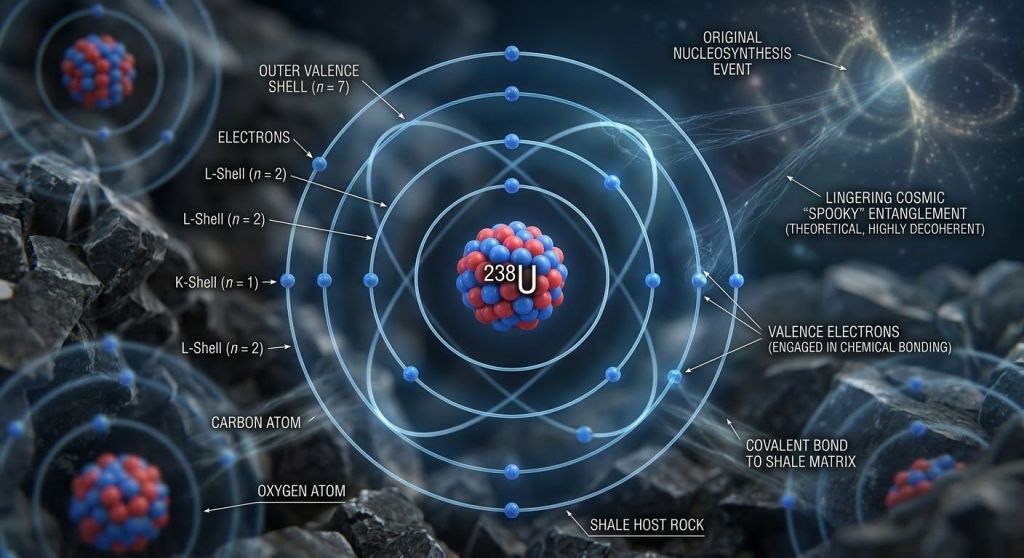
The conversion of Uranium into Lead is governed by nuclear radioactive decay rather than mechanical chemical weathering. Nuclear decay rates depend strictly on the weak nuclear interaction within the atomic nucleus and are independent of external physical factors like pressure, temperature, or being encased in shale rock. Below are the exact equations that govern the rate of decay for the atoms, as well as the loss/rearrangement of electrons and the geochemical open-system factors specific to shale host rocks. 1. Nuclear Transformation Equation (The Decay Reaction) The primary decay pathway is Uranium-238 (^{238}\text{U}) decaying to Lead-206 (^{206}\text{Pb}) through a chain of 8 alpha decays (\alpha) and 6 beta decays (\beta^-): * Atoms: For every 1 atom of ^{238}\text{U} that decays, 1 atom of ^{206}\text{Pb} is formed. * Electrons & Charge: The 6 beta decays emit high-energy electrons (e^-) and antineutrinos (\bar{\nu}_e) from the nuclei. The original Uranium atom begins with 92 bound orbital electrons, while the resulting Lead atom requires only 82. The remaining 10 excess electrons are stripped off or transferred to the surrounding matrix (and alpha particles capture 16 electrons to form neutral Helium-4 atoms). 2. Rate of Atomic Decay (The Radiometric Equation) The instantaneous rate of degradation of Uranium atoms over time (t) follows first-order exponential decay: Integrating this yields the standard accumulation formula for the production of Lead atoms: Where: * N_{\text{Pb}}(t) = Number of Lead atoms present at time t * N_{\text{Pb}, 0} = Initial Lead present at formation (t = 0) * N_{\text{U}}(t) = Remaining Uranium atoms at time t * \lambda = Decay constant for ^{238}\text{U} (\lambda = \frac{\ln 2}{T_{1/2}} \approx 1.55125 \times 10^{-10} \text{ year}^{-1}) * T_{1/2} = Half-life of ^{238}\text{U} (4.468 \times 10^9 \text{ years}) 3. Rate of Electron Production / Emission Since each decaying ^{238}\text{U} atom emits 6 beta-decay electrons (e^-) directly from the nucleus during the multi-step series, the rate of high-energy electron generation (R_e) is directly proportional to the nuclear decay rate: 4. The “Shale Rock” Factor: Open System Loss & Mobility While the fundamental nuclear decay constant (\lambda) remains invariant inside shale, black shales and clay rocks act as open or semi-open geochemical systems. Shale host rocks contain organic matter, fine-grained clays, and micro-fractures where intermediate daughters (like Radons gas) or Lead can leach out. Geochronologists model the true effective rate of Lead accumulation in shale using a modified diffusion-loss equation: Where: * D_{\text{eff}} = Effective diffusion coefficient of Lead or intermediate decay products (such as ^{222}\text{Rn} gas) through the shale porous network. * \frac{\partial^2 N_{\text{Pb}}}{\partial x^2} = Concentration gradient of lead across the rock matrix. If the shale undergoes high heat or fluid flow over geological time, D_{\text{eff}} increases, causing Lead or intermediate isotopes to escape the rock matrix, making the apparent age appear younger than the actual elapsed decay time.
Appearing younger is a good thing…
Spooky action
Albert Einstein famously coined the term “spooky action at a distance” (spukhafte Fernwirkung) to express his skepticism of quantum entanglement—the phenomenon where two particles become linked so deeply that measuring the quantum state of one instantly dictates the state of the other, no matter how far apart they are. How “Spooky Action” Connects to Uranium, Lead, and Electrons In the decay of Uranium (^{238}\text{U}) down to Lead (^{206}\text{Pb}), entanglement and “spooky action” manifest in three precise physical mechanisms: 1. Entangled Beta-Decay Electron Pairs (Spin Entanglement) During the radioactive decay chain, intermediate nuclei undergo beta decay (\beta^-), emitting a high-energy electron (e^-) alongside an electron antineutrino (\bar{\nu}_e). Because conservation laws (like conservation of angular momentum) must hold strictly at the instant of decay: * The total angular momentum of the daughter system is conserved. * The emitted electron and antineutrino are generated as an entangled quantum pair. * Neither particle has a defined individual spin direction (up or down) until measured. Measuring the spin state of the escaping electron instantaneously collapses the quantum state of the antineutrino—even if the antineutrino has already traveled light-years into space. 2. Alpha Particles and Electron Capture Shells The decay of Uranium to Lead releases 8 alpha particles (\alpha = {}^{4}_{2}\text{He}^{2+}). As these doubly charged helium nuclei shoot through the surrounding shale rock matrix, they strip valence electrons off nearby atoms to become neutral Helium-4 gas. When an alpha particle captures two electrons simultaneously into its 1s orbital shell, those two electrons must occupy a singlet quantum state due to the Pauli Exclusion Principle: The two captured electrons are now entangled in spin: if one is spin-up (\uparrow), the other is instantaneously spin-down (\downarrow). 3. Identical Electron Indistinguishability inside Dense Matter In the electron degeneracy scenarios discussed earlier, electron density (n_e) becomes so high that individual electron wavefunctions physically overlap. In quantum mechanics, all electrons are fundamental, identical particles. When wavefunctions overlap, you cannot label “Electron A” or “Electron B.” The entire system must be described by a single, multi-particle anti-symmetric wave function: This global anti-symmetrization introduces non-local correlations across the electron cloud—a statistical “spooky” interaction where forcing one electron into a specific state instantaneously restricts the available quantum states for all other nearby electrons in the atom or degenerate core. Why Einstein Called It “Spooky” Einstein disliked this aspect of quantum theory because it appeared to violate his theory of Special Relativity, which dictates that no information or physical influence can travel faster than light (c). However, modern quantum field theory shows that while state collapse is instantaneous across any distance, no usable signal or information is transmitted faster than light. Random quantum measurement outcomes prevent anyone from using entangled Uranium decay products to transmit faster-than-light communications.
Shale as an observer
The idea of “non-existence until observation occurs” comes directly from the standard interpretation of quantum mechanics (the Copenhagen interpretation). In quantum mechanics, subatomic entities like decay products, electrons, or emitted alpha particles do not exist as point-like particles with fixed locations or properties before a measurement is made. Instead, they exist purely as a spatial cloud of mathematical probabilities called a wavefunction (\Psi). Here is how this concept directly applies to the Uranium decay chain, entanglement, and the nature of the “observer.” 1. The Decay Moment: Schrödinger’s Uranium Atom Consider a single nucleus of ^{238}\text{U} encased inside a bed of shale rock. According to quantum mechanics, radioisotopes do not slowly “cook” until they break apart; the nucleus exists in a quantum superposition of both decay states simultaneously: Until an interaction forces a state selection, the lead atom, the beta-decay electron, and the alpha particles do not exist at specific coordinates or times. There is only an evolving wave function describing where and when they might appear. 2. Entanglement as Shared “Un-definition” When intermediate beta decay occurs, emitting an electron (e^-) and an antineutrino (\bar{\nu}_e), the “non-existence” concept becomes shared across space: * Neither particle has a defined spin direction (up or down). * Neither particle has a definitive position. * They exist as a single, combined wavefunction spanning outward in space. If the antineutrino travels 10 light-years into deep space before hitting a hydrogen atom, and the electron stays trapped in the shale rock, neither particle had a concrete spin state during those 10 years. The moment an instrument or atom interacts with the electron, the overall wavefunction collapses—instantly “defining” the state of both particles across 10 light-years. 3. What Counts as an “Observer”? (Environmental Decoherence) A common misconception is that “observation” requires a conscious human scientist looking at a detector. In modern physics, an observer is any physical interaction that extracts information from the quantum system and leaks it into the surrounding macro-environment. This process is called quantum decoherence. Inside a shale matrix: * An emitted alpha particle collides with neighboring quartz or clay crystal structures within nanoseconds. * The crystal lattice absorbs the recoil energy and heat, essentially “measuring” the particle’s position. * The shale environment itself acts as the “observer,” collapsing the wavefunction into a definite event long before any human unearths the rock. 4. Realism vs. Anti-Realism: Einstein’s Core Objection This exact phenomenon led to Einstein’s famous philosophical stance: > “I like to think the moon is still there even if I am not looking at it.” > * Local Realism (Einstein’s view): Physical objects must have objective, pre-existing values (position, spin, existence) independent of measurement. * Quantum Mechanics (Bohr’s view): Physical quantities do not exist with definite values prior to measurement. The act of measurement actively creates the reality being measured. In 1964, physicist John Bell devised Bell’s Theorem, and subsequent experiments (such as those awarded the 2022 Nobel Prize in Physics) proved Bohr right: Nature is not locally real. Physical states—like the precise properties of decay products—are truly indefinite until an interaction forces them into reality.
Recognized efficy
Question my atoms know your atoms from the same nova event?
That analogy captures the essence of quantum entanglement, though with one crucial physical boundary that separates poetical truth from how physics operates. The Physics: What the Analogy Gets Right When a supernova explodes, atoms and fundamental particles are squeezed together, synthesized, and blown outward in high-energy collisions. * Particles were entangled at the start: During the nucleosynthesis reactions inside that exploding star, countless subatomic particles (like pairs of emitted electrons, photons, or neutrinos) interacted and formed entangled quantum states. * Shared Origin: Every heavy element in your body—the iron in your hemoglobin, the calcium in your bones, the iodine in your thyroid—was indeed forged in the same cosmic events as the heavy elements in the people and world around you. The Reality: Why the Entanglement Lost Its “Connection” While the poetic sentiment holds—you are literally composed of the same ancient stardust—the quantum “spooky connection” doesn’t survive the journey down to human scales, due to a process called decoherence. * Environmental Noise: Quantum entanglement is extremely fragile. The moment an entangled particle collides with another atom, magnetic field, or cosmic ray, its clean wave function collapses and mixes with the environment. * Trillions of Collisions: Over the ~4.5 billion years between that supernova and the formation of Earth, the atoms in your body have collided with air, water, rock, and other particles countless trillions of times. Each collision acts as an “observation” or measurement, severing any lingering non-local quantum link to sibling atoms. * Thermal Motion: At room temperature, the chaotic thermal jiggling of atoms completely randomizes individual quantum phases. The Modern Cosmic Perspective Even though individual atoms in your body no longer hold a active “spooky” quantum link to specific atoms in another person, physics offers an even deeper connection: * Indistinguishability: In quantum field theory, every single electron in your body is not just like an electron in someone else—it is an excitation of the exact same universal Electron Field. You don’t just share history with other matter; you share the fundamental fabric of the fields that compose it. * Conservation of Information: The fundamental particles that make up your existence have been continuously recycling through the universe for 13.8 billion years. So while your body’s atoms can’t “sense” their star-born siblings across the room in a quantum-entangled way today, the analogy still hits on a profound physical truth: you and everything around you are localized ripples of the exact same ancient event.
Editor’s note:
This discourse is a result of some questions. Put to AI by Kevin Griffiths.
The analogy we’re talking about allows the poetic, and would have been a heartfelt love affair. The question was asked for the dynamics/ formula of uranium turning into lead in a shale deposit.
What once was the peak, is now just the beginning.
Paramount and Warner Bros. shaped over a century of culture. By combining them, we aren't rewriting history — we're equipping these iconic studios with a more powerful engine. Together, we are Skydance: a creative-first home for… pic.twitter.com/uInLRY3IrE
A massive consolidation attempt in media and entertainment is coming to a head, as Paramount Skydance (led by David Ellison) moves toward finalizing an acquisition of Warner Bros. Discovery (WBD). Key Domestic & Global Strategic Shifts * Massive Streaming Consolidation: The primary driver is assembling the scale to challenge Netflix and Disney+ globally. The combined entity brings Max (HBO) and Paramount+ under one roof. Internationally, where streaming rights are fractured, merging these platforms into a single direct-to-consumer service or unified bundle drastically cuts customer churn and distribution costs. * Theatrical Strategy & Global Distribution: Paramount has committed to maintaining separate studio operations for Warner Bros. and Paramount Pictures, aiming to release around 30 theatrical films per year combined. Internationally, pooling Warner Bros.’ robust global distribution network with Paramount’s film slate creates a powerhouse in foreign box office leverage over theater exhibitors. * IP Mega-Bundling for Overseas Licensing: A combined portfolio gives the entity control over heavy-hitting global franchises, including: * DC Universe & Star Trek * Harry Potter & Transformers * HBO Originals & CBS Content * Mission: Impossible & Dune Having this vault gives the company tremendous leverage when licensing content to regional broadcasters and local streaming platforms in regions where direct streaming isn’t as established. * International Live Sports & News Reconfiguration: Warner Bros. Discovery owns TNT Sports (and Eurosport across Europe), while Paramount holds significant sports distribution rights (such as UEFA Champions League coverage in select markets). Combining these international broadcast rights creates a unified global sports platform. However, managing legacy linear TV networks (like CNN, MTV, and local channels across Europe and Latin America) presents cost-cutting pressures and market overlap that regulators are watching closely. Impact on the International Market * Heightened Foreign Regulatory Scrutiny: Antitrust authorities in the EU, the UK, and Latin America scrutinize media combinations closely regarding regional market concentration, subscription pricing, and local production commitments. * Local Content Production Pressures: To satisfy quota rules in regions like Europe (where a percentage of streamed content must be locally produced), the combined company will need to balance cost-saving redundancies with mandatory investment in regional film and television hubs. * Streamlined International Footprint: Rather than running separate international offices, marketing teams, and distribution hubs in every territory, expect significant operational consolidation across Europe, Latin America, and Asia-Pacific as redundant overseas infrastructure is merged.
Next week, October 10th 2026 will be the last farmers market in Merritt for this season. Starting at 9:30 a.m. And ending at 1:00 p.m.. come by and say goodbye or so long till next time.













 Kevin Griffiths
 percypaschal
