
Tag Archive: Rivers


Basket of life

Rivers of life
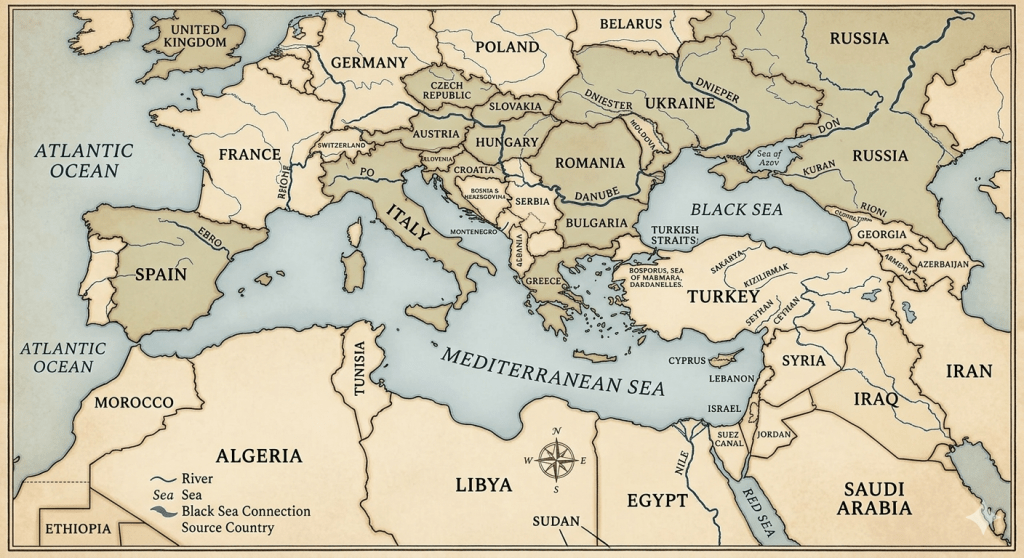
The rivers that flow into the Black Sea—most notably the Danube, Dnieper, Dniester, and Don—serve as vital ecological, economic, and geopolitical lifelines for Central and Eastern Europe.

These vast freshwater systems act as natural highways, enabling international trade and commercial navigation deep into the European interior.

Beyond transportation, they supply critical freshwater for agricultural irrigation across vast agricultural belts and sustain unique delta ecosystems, such as the UNESCO-protected Danube Delta, which are rich in biodiversity and serve as essential habitats for migratory birds and endangered fish species. Furthermore, these rivers continuously deposit nutrients that dictate the unique marine chemistry and fish populations of the Black Sea itself, making them indispensable to the regional fishing industry and the livelihoods of littoral nations.
Regarding energy generation, the technical and economic exploitation of these river systems varies dramatically by region. On the Upper Danube and parts of the Dnieper, the hydroelectric potential is largely exhausted;

Decades of intensive development have resulted in major installations like the massive Iron Gate dams (shared by Romania and Serbia) and the multi-dam cascade system in Ukraine. While localized, micro-hydro upgrades and modernizations continue to tap small fragments of remaining energy, any substantial large-scale potential remains intentionally undeveloped. This is due to strict European Union environmental mandates, such as the Water Framework Directive, alongside concerted efforts by international commissions to protect remaining free-flowing river stretches from hydromorphological damage. Consequently, regional energy focus has shifted away from building new river dams and toward expanding offshore wind, wave energy, and deepwater subsea energy corridors across the Black Sea basin.


For a deep dive into how these massive river systems impact underwater geography and deep-sea environments, you might find this video highly insightful:
Scientists Found Enormous River Flowing Under the Black Sea
This video explores how the unique interaction between the Black Sea and inbound water sources creates fascinating, hidden underwater river currents right along the seabed.

The Blue Danube, seen by many eyes over millenium still rolls on in its solumn wait for yours…
Cooler weather

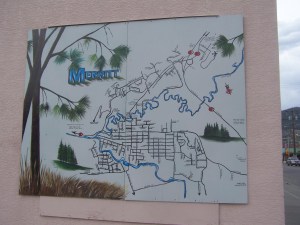
City map on a shop on Voght Street.
File photo: KDG

The above map was made by a local sign painter some years ago, the art depicts the disposition of the two local rivers passing through Merritt BC.

Overnight brought a low pressure front to us in the Merritt area and a pronounced drop in temperature bringing the Nicola River level down about a foot at the Voght Street bridge, picnic  park semi submerged picnic table scale. Water also retreated back and past the last cross street/cul de sac on Garcia.
The overnight also brought rain and snow and snow is visible at the 4000 ft. level on Iron Mountain.

On this Day: May 24th 1940
Igor Sikorsky flies a single rotor helicopter for the first time.

Otter

DSC_3709 (7)

No its not the Ogopogo it was a fast moving energetic River Otter, in the Nicola river last week.

otter

From Wikipedia, the free encyclopedia
Jump to: navigation, search
North American river otter
LutraCanadensis fullres.jpg
Scientific classification
Kingdom: Animalia
Phylum: Chordata
Class: Mammalia
Order: Carnivora
Family: Mustelidae
Genus: Lontra
Species: L. canadensis
Binomial name
Lontra canadensis
(Schreber, 1777)
Subspecies
see text
LontraCanadensisMap.svg
Synonyms
Lutra canadensis

The North American river otter (Lontra canadensis), also known as the northern river otter or the common otter, is a semiaquatic mammal endemic to the North American continent found in and along its waterways and coasts. An adult river otter can weigh between 5.0 and 14 kg (11.0 and 30.9 lb). The river otter is protected and insulated by a thick, water-repellent coat of fur.

The river otter, a member of the subfamily Lutrinae in the weasel family (Mustelidae), is equally versatile in the water and on land. It establishes a burrow close to the water’s edge in river, lake, swamp, coastal shoreline, tidal flat, or estuary ecosystems. The den typically has many tunnel openings, one of which generally allows the otter to enter and exit the body of water. Female otters give birth in these underground burrows, producing litters of one to six young.

North American river otters, like most predators, prey upon the most readily accessible species. Fish is a favored food among the otters, but they also consume various amphibians (such as salamanders and frogs[2]), freshwater clams, mussels, snails, small turtles and crayfish. Instances of river otters eating small mammals and occasionally birds have been reported as well.


On this Day: April 25th 1959

The Saint Lawrence Seaway  better opens Canada to the Atlantic Ocean.