
Tarot what is it?
To understand Tarot, it helps to start with what it physically is: a standardized deck of 78 cards featuring symbolic imagery.
Originally created in 15th-century Northern Italy, Tarot began not as a mystical tool, but as a parlor game for wealthy nobles called *Tarocchi* (similar to modern bridge). It wasn’t until the late 18th century that French occultists reinterpreted the vivid, allegorical pictures as a tool for divination and introspective reflection.
Here is how Tarot aligns with the categories you asked about:
## 1. Is it a Religion?
**No.** Tarot has no dogma, central deity, scriptures, or required system of worship.
People of virtually any religious background—or none at all—use Tarot. While some modern pagan, Wiccan, or esoteric spiritual practices incorporate the cards into their rituals, the deck itself is simply a medium, much like a journal or an art collection.
## 2. Is it a Discipline?
**Yes, in a practical and psychological sense.**
Learning Tarot requires study and structured practice. A reader must memorize the foundational meanings of all 78 cards (split into the 22 “Major Arcana” representing big life lessons, and 56 “Minor Arcana” dealing with daily events) and learn how various visual motifs interact.
In modern psychology—starting with Carl Jung—Tarot is studied as a **system of archetypes**. Many readers use it non-mystically as a introspective tool. Because the cards represent universal human experiences (grief, transition, ambition, balance), looking at a random card prompt can help a person organize their thoughts, mirror their subconscious feelings, or view a problem from a new perspective.
## 3. Is it a Superstition?
**It depends on how it is used.**
* **If used for fortune-telling:** If someone believes the cards hold supernatural power to predict precise, literal future events (e.g., “This card proves you will win the lottery on Tuesday”), mainstream science and logic treat that as a superstition. The physical order of a shuffled deck is purely random.
* **If used for reflection:** If viewed instead as a set of visual storytelling prompts to trigger self-reflection, there is no superstition involved—just visual metaphor and creative interpretation.
## 4. Does it have Astronomical / Professional Value?
**In terms of modern astronomy, no.** Tarot has no scientific or observational value for studying outer space, celestial mechanics, or physical star movements. Astronomy is an empirical science; Tarot is symbolic art.
**However, there is a historical connection to Astrology:**
In the late 19th and early 20th centuries, occult societies (like the Hermetic Order of the Golden Dawn) mapped standard astrological symbols—such as the 12 zodiac signs and classical planets—onto individual Tarot cards.
Tarot Card Astrological Association
|—|—|
| **The Emperor** | Aries (pioneering energy, leadership) |
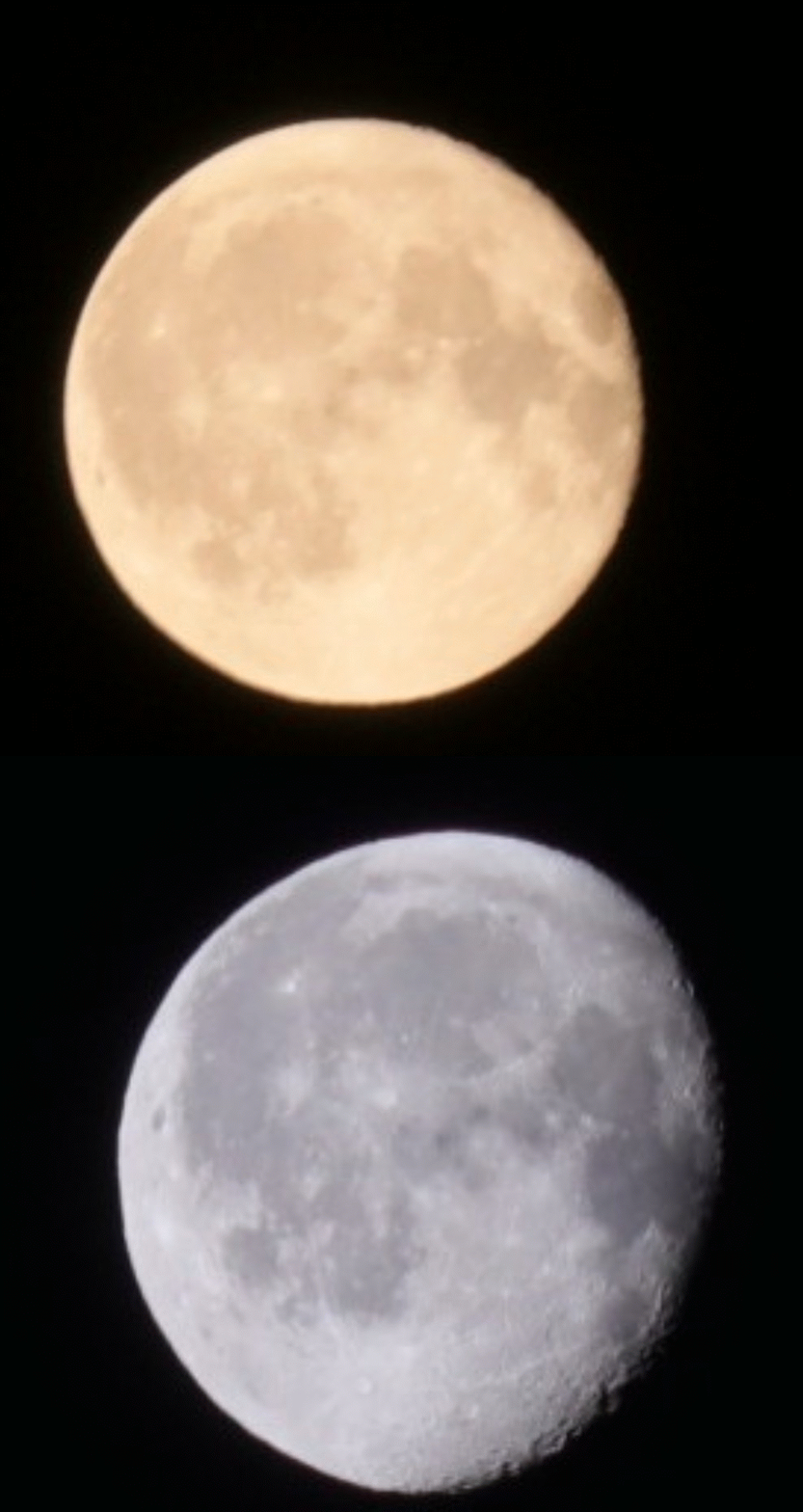
| **The High Priestess** | The Moon (intuition, hidden knowledge) |
| **The Star** | Aquarius (hope, perspective, inspiration) |
While astronomers do not recognize these connections, historians, art scholars, and professional mythologists study Tarot for its rich iconographic history and cultural impact across Europe over the last 500 years.
Environment Canada yellow warning for air quality Merritt BC.
Impact level moderate…


 Kevin Griffiths
 percypaschal
