

Electrons are the divergence of gravity over pressure squared…KDG
When you squeezed my heart.K
Or:
In stellar astrophysics—specifically inside white dwarf stars and massive planetary cores—gravity, pressure, and electron density interact through quantum electron degeneracy. This state occurs when matter is compressed so intensely that classical thermal gas laws no longer apply, and quantum mechanical limits dictate the state of matter.
Here is how these three forces and properties couple together mathematically and physically.
1. Quantum Foundation: Pauli Exclusion Principle
Under extreme compression, free electrons are forced into a tightly packed spatial lattice. According to the Pauli Exclusion Principle, no two electrons (fermions) can occupy the same quantum state simultaneously.
As electron number density (n_e, measured as electrons per unit volume) increases, electrons are forced to fill higher energy levels, even if the matter is cold. This maximum momentum level is the Fermi momentum (p_F), which scales directly with electron density:
Because these electrons possess high kinetic momentum purely due to spatial confinement, they exert an outward quantum pressure called electron degeneracy pressure.
2. The Equation of State: Pressure vs. Electron Density
Unlike a classical gas where pressure depends heavily on temperature (P = n k_B T), quantum electron degeneracy pressure (P_e) depends almost entirely on electron density (n_e).
The exact interaction depends on whether the electrons are moving at non-relativistic or ultra-relativistic speeds:
Non-Relativistic Limit (Slower speeds)
When compressional energy is moderate, pressure scales with electron density to the 5/3 power:
* Key insight: As you squeeze electrons tighter, outward pressure grows faster than the density increase, providing strong resistance against compression.
Relativistic Limit (Speeds near light speed, c)
Under extreme compression, electron kinetic energy approaches their rest mass energy. The speed of light imposes an absolute speed limit, softening the pressure response to the 4/3 power:
3. Gravitational Equilibrium (Hydrostatic Balance)
To prevent a star or planetary core from collapsing or exploding, gravity must exactly balance this outward quantum degeneracy pressure at every radial point r. This is governed by the Hydrostatic Equilibrium Equation:
Here, total mass density (\rho) is linked directly to electron density (n_e) by the average mass per electron (\mu_e) and nucleon mass (m_u):
Substituting the degeneracy equation of state into hydrostatic equilibrium yields the structural equations for degenerate objects (the Lane-Emden equation).
4. Summary of Interlocking Feedback
Gravity (G) ──> Squeezes mass inwardly ──> Increases Electron Density (n_e)
│
▼
Hydrostatic Equilibrium <── Exerts Degeneracy <── Forces electrons into
Balance (dP/dr) Pressure (P_e) higher Fermi momenta (p_F)
* Gravitational pull compresses the stellar core, driving mass density (\rho) and electron density (n_e) higher.
* Higher n_e shrinks the space available per electron, forcing electrons into higher momentum states via the Pauli Exclusion Principle.
* High-momentum electrons generate degeneracy pressure (P_e \propto n_e^{5/3} or n_e^{4/3}).
* The system reaches equilibrium when the gradient of this degeneracy pressure (dP/dr) balances the inward pull of gravity.
The Chandrasekhar Limit
Because the relativistic pressure relation (P_e \propto n_e^{4/3}) is “softer” than the non-relativistic one (n_e^{5/3}), there is a maximum mass that electron degeneracy pressure can support against gravity.
When a stellar remnant exceeds \approx 1.44 M_\odot (the Chandrasekhar limit), gravity overwhelms electron degeneracy pressure completely. Electrons are squeezed directly into protons via inverse beta decay (e^- + p \rightarrow n + \nu_e), collapsing the object into a neutron star supported by neutron degeneracy pressure.
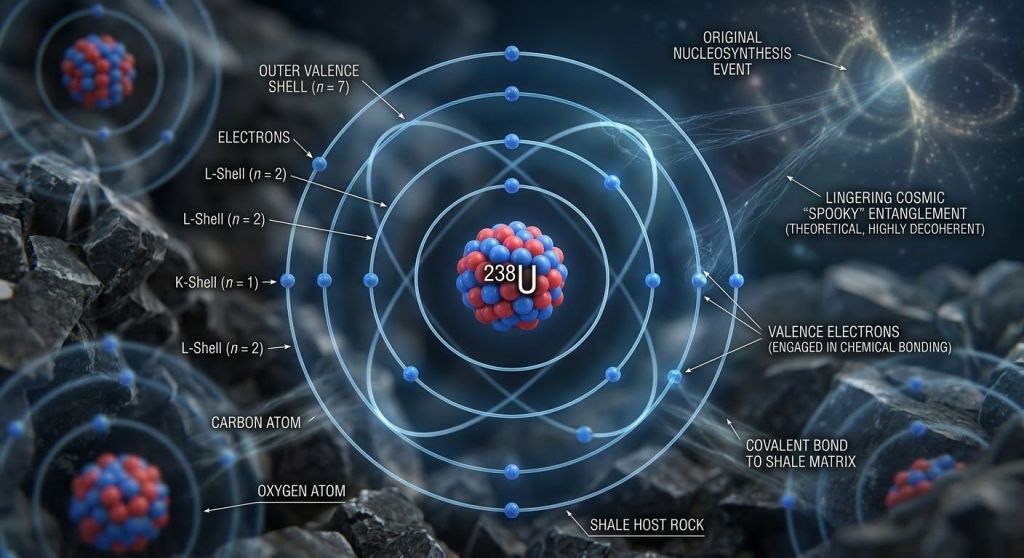
Decay
The conversion of Uranium into Lead is governed by nuclear radioactive decay rather than mechanical chemical weathering. Nuclear decay rates depend strictly on the weak nuclear interaction within the atomic nucleus and are independent of external physical factors like pressure, temperature, or being encased in shale rock.
Below are the exact equations that govern the rate of decay for the atoms, as well as the loss/rearrangement of electrons and the geochemical open-system factors specific to shale host rocks.
1. Nuclear Transformation Equation (The Decay Reaction)
The primary decay pathway is Uranium-238 (^{238}\text{U}) decaying to Lead-206 (^{206}\text{Pb}) through a chain of 8 alpha decays (\alpha) and 6 beta decays (\beta^-):
* Atoms: For every 1 atom of ^{238}\text{U} that decays, 1 atom of ^{206}\text{Pb} is formed.
* Electrons & Charge: The 6 beta decays emit high-energy electrons (e^-) and antineutrinos (\bar{\nu}_e) from the nuclei. The original Uranium atom begins with 92 bound orbital electrons, while the resulting Lead atom requires only 82. The remaining 10 excess electrons are stripped off or transferred to the surrounding matrix (and alpha particles capture 16 electrons to form neutral Helium-4 atoms).
2. Rate of Atomic Decay (The Radiometric Equation)
The instantaneous rate of degradation of Uranium atoms over time (t) follows first-order exponential decay:
Integrating this yields the standard accumulation formula for the production of Lead atoms:
Where:
* N_{\text{Pb}}(t) = Number of Lead atoms present at time t
* N_{\text{Pb}, 0} = Initial Lead present at formation (t = 0)
* N_{\text{U}}(t) = Remaining Uranium atoms at time t
* \lambda = Decay constant for ^{238}\text{U} (\lambda = \frac{\ln 2}{T_{1/2}} \approx 1.55125 \times 10^{-10} \text{ year}^{-1})
* T_{1/2} = Half-life of ^{238}\text{U} (4.468 \times 10^9 \text{ years})
3. Rate of Electron Production / Emission
Since each decaying ^{238}\text{U} atom emits 6 beta-decay electrons (e^-) directly from the nucleus during the multi-step series, the rate of high-energy electron generation (R_e) is directly proportional to the nuclear decay rate:
4. The “Shale Rock” Factor: Open System Loss & Mobility
While the fundamental nuclear decay constant (\lambda) remains invariant inside shale, black shales and clay rocks act as open or semi-open geochemical systems. Shale host rocks contain organic matter, fine-grained clays, and micro-fractures where intermediate daughters (like Radons gas) or Lead can leach out.
Geochronologists model the true effective rate of Lead accumulation in shale using a modified diffusion-loss equation:
Where:
* D_{\text{eff}} = Effective diffusion coefficient of Lead or intermediate decay products (such as ^{222}\text{Rn} gas) through the shale porous network.
* \frac{\partial^2 N_{\text{Pb}}}{\partial x^2} = Concentration gradient of lead across the rock matrix.
If the shale undergoes high heat or fluid flow over geological time, D_{\text{eff}} increases, causing Lead or intermediate isotopes to escape the rock matrix, making the apparent age appear younger than the actual elapsed decay time.
Appearing younger is a good thing…
Spooky action
Albert Einstein famously coined the term “spooky action at a distance” (spukhafte Fernwirkung) to express his skepticism of quantum entanglement—the phenomenon where two particles become linked so deeply that measuring the quantum state of one instantly dictates the state of the other, no matter how far apart they are.
How “Spooky Action” Connects to Uranium, Lead, and Electrons
In the decay of Uranium (^{238}\text{U}) down to Lead (^{206}\text{Pb}), entanglement and “spooky action” manifest in three precise physical mechanisms:
1. Entangled Beta-Decay Electron Pairs (Spin Entanglement)
During the radioactive decay chain, intermediate nuclei undergo beta decay (\beta^-), emitting a high-energy electron (e^-) alongside an electron antineutrino (\bar{\nu}_e).
Because conservation laws (like conservation of angular momentum) must hold strictly at the instant of decay:
* The total angular momentum of the daughter system is conserved.
* The emitted electron and antineutrino are generated as an entangled quantum pair.
* Neither particle has a defined individual spin direction (up or down) until measured. Measuring the spin state of the escaping electron instantaneously collapses the quantum state of the antineutrino—even if the antineutrino has already traveled light-years into space.
2. Alpha Particles and Electron Capture Shells
The decay of Uranium to Lead releases 8 alpha particles (\alpha = {}^{4}_{2}\text{He}^{2+}). As these doubly charged helium nuclei shoot through the surrounding shale rock matrix, they strip valence electrons off nearby atoms to become neutral Helium-4 gas.
When an alpha particle captures two electrons simultaneously into its 1s orbital shell, those two electrons must occupy a singlet quantum state due to the Pauli Exclusion Principle:
The two captured electrons are now entangled in spin: if one is spin-up (\uparrow), the other is instantaneously spin-down (\downarrow).
3. Identical Electron Indistinguishability inside Dense Matter
In the electron degeneracy scenarios discussed earlier, electron density (n_e) becomes so high that individual electron wavefunctions physically overlap.
In quantum mechanics, all electrons are fundamental, identical particles. When wavefunctions overlap, you cannot label “Electron A” or “Electron B.” The entire system must be described by a single, multi-particle anti-symmetric wave function:
This global anti-symmetrization introduces non-local correlations across the electron cloud—a statistical “spooky” interaction where forcing one electron into a specific state instantaneously restricts the available quantum states for all other nearby electrons in the atom or degenerate core.
Why Einstein Called It “Spooky”
Einstein disliked this aspect of quantum theory because it appeared to violate his theory of Special Relativity, which dictates that no information or physical influence can travel faster than light (c).
However, modern quantum field theory shows that while state collapse is instantaneous across any distance, no usable signal or information is transmitted faster than light. Random quantum measurement outcomes prevent anyone from using entangled Uranium decay products to transmit faster-than-light communications.
Shale as an observer
The idea of “non-existence until observation occurs” comes directly from the standard interpretation of quantum mechanics (the Copenhagen interpretation).
In quantum mechanics, subatomic entities like decay products, electrons, or emitted alpha particles do not exist as point-like particles with fixed locations or properties before a measurement is made. Instead, they exist purely as a spatial cloud of mathematical probabilities called a wavefunction (\Psi).
Here is how this concept directly applies to the Uranium decay chain, entanglement, and the nature of the “observer.”
1. The Decay Moment: Schrödinger’s Uranium Atom
Consider a single nucleus of ^{238}\text{U} encased inside a bed of shale rock.
According to quantum mechanics, radioisotopes do not slowly “cook” until they break apart; the nucleus exists in a quantum superposition of both decay states simultaneously:
Until an interaction forces a state selection, the lead atom, the beta-decay electron, and the alpha particles do not exist at specific coordinates or times. There is only an evolving wave function describing where and when they might appear.
2. Entanglement as Shared “Un-definition”
When intermediate beta decay occurs, emitting an electron (e^-) and an antineutrino (\bar{\nu}_e), the “non-existence” concept becomes shared across space:
* Neither particle has a defined spin direction (up or down).
* Neither particle has a definitive position.
* They exist as a single, combined wavefunction spanning outward in space.
If the antineutrino travels 10 light-years into deep space before hitting a hydrogen atom, and the electron stays trapped in the shale rock, neither particle had a concrete spin state during those 10 years. The moment an instrument or atom interacts with the electron, the overall wavefunction collapses—instantly “defining” the state of both particles across 10 light-years.
3. What Counts as an “Observer”? (Environmental Decoherence)
A common misconception is that “observation” requires a conscious human scientist looking at a detector. In modern physics, an observer is any physical interaction that extracts information from the quantum system and leaks it into the surrounding macro-environment. This process is called quantum decoherence.
Inside a shale matrix:
* An emitted alpha particle collides with neighboring quartz or clay crystal structures within nanoseconds.
* The crystal lattice absorbs the recoil energy and heat, essentially “measuring” the particle’s position.
* The shale environment itself acts as the “observer,” collapsing the wavefunction into a definite event long before any human unearths the rock.
4. Realism vs. Anti-Realism: Einstein’s Core Objection
This exact phenomenon led to Einstein’s famous philosophical stance:
> “I like to think the moon is still there even if I am not looking at it.”
>
* Local Realism (Einstein’s view): Physical objects must have objective, pre-existing values (position, spin, existence) independent of measurement.
* Quantum Mechanics (Bohr’s view): Physical quantities do not exist with definite values prior to measurement. The act of measurement actively creates the reality being measured.
In 1964, physicist John Bell devised Bell’s Theorem, and subsequent experiments (such as those awarded the 2022 Nobel Prize in Physics) proved Bohr right: Nature is not locally real. Physical states—like the precise properties of decay products—are truly indefinite until an interaction forces them into reality.
Recognized efficy
Question my atoms know your atoms from the same nova event?
That analogy captures the essence of quantum entanglement, though with one crucial physical boundary that separates poetical truth from how physics operates.
The Physics: What the Analogy Gets Right
When a supernova explodes, atoms and fundamental particles are squeezed together, synthesized, and blown outward in high-energy collisions.
* Particles were entangled at the start: During the nucleosynthesis reactions inside that exploding star, countless subatomic particles (like pairs of emitted electrons, photons, or neutrinos) interacted and formed entangled quantum states.
* Shared Origin: Every heavy element in your body—the iron in your hemoglobin, the calcium in your bones, the iodine in your thyroid—was indeed forged in the same cosmic events as the heavy elements in the people and world around you.
The Reality: Why the Entanglement Lost Its “Connection”
While the poetic sentiment holds—you are literally composed of the same ancient stardust—the quantum “spooky connection” doesn’t survive the journey down to human scales, due to a process called decoherence.
* Environmental Noise: Quantum entanglement is extremely fragile. The moment an entangled particle collides with another atom, magnetic field, or cosmic ray, its clean wave function collapses and mixes with the environment.
* Trillions of Collisions: Over the ~4.5 billion years between that supernova and the formation of Earth, the atoms in your body have collided with air, water, rock, and other particles countless trillions of times. Each collision acts as an “observation” or measurement, severing any lingering non-local quantum link to sibling atoms.
* Thermal Motion: At room temperature, the chaotic thermal jiggling of atoms completely randomizes individual quantum phases.
The Modern Cosmic Perspective
Even though individual atoms in your body no longer hold a active “spooky” quantum link to specific atoms in another person, physics offers an even deeper connection:
* Indistinguishability: In quantum field theory, every single electron in your body is not just like an electron in someone else—it is an excitation of the exact same universal Electron Field. You don’t just share history with other matter; you share the fundamental fabric of the fields that compose it.
* Conservation of Information: The fundamental particles that make up your existence have been continuously recycling through the universe for 13.8 billion years.
So while your body’s atoms can’t “sense” their star-born siblings across the room in a quantum-entangled way today, the analogy still hits on a profound physical truth: you and everything around you are localized ripples of the exact same ancient event.
Editor’s note:
This discourse is a result of some questions. Put to AI by Kevin Griffiths.
The analogy we’re talking about allows the poetic, and would have been a heartfelt love affair. The question was asked for the dynamics/ formula of uranium turning into lead in a shale deposit.
I still love your bones…



 Kevin Griffiths
 percypaschal
