

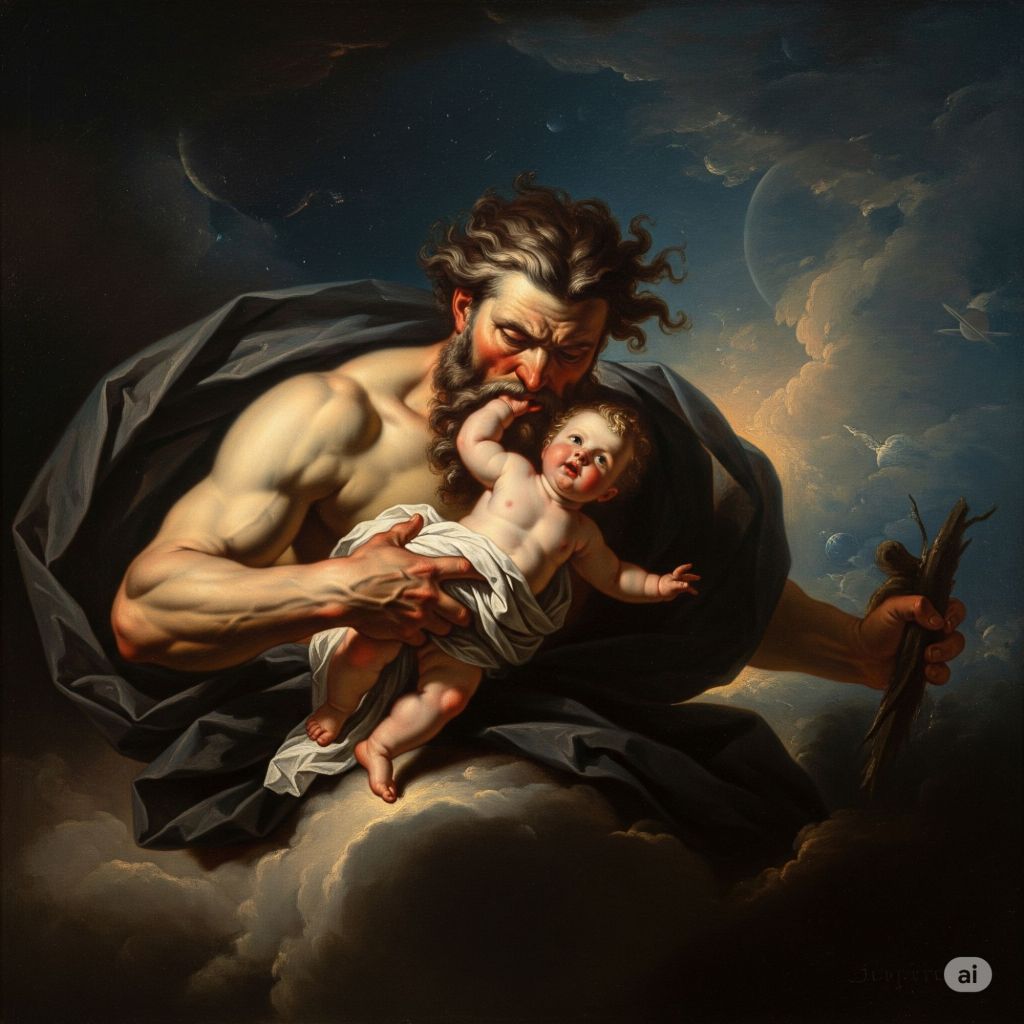
The myth of Jupiter eating his son is a Roman version of the Greek myth of Cronus (the Titan god of time) and his children. It’s a foundational story in ancient mythology, explaining the succession of power among the gods.
Here is what the myth is about:
The Prophecy and the Act
The story begins with a prophecy that Cronus would be overthrown by one of his own children, just as he had overthrown his father, Uranus (the Sky). Driven by paranoia and a desire to retain his power, Cronus devoured each of his children as they were born. His wife, Rhea, was heartbroken and, when her sixth child, Zeus (Jupiter in Roman mythology), was born, she decided to save him.
Rhea hid the infant Zeus in a cave on the island of Crete and, to deceive Cronus, she gave him a stone wrapped in swaddling clothes. Cronus, not noticing the deception, swallowed the stone, believing he had successfully consumed his final child.
Zeus grew up in secret and, once he was an adult, he returned to confront his father. He forced Cronus to regurgitate his siblings—Hestia, Demeter, Hera, Hades, and Poseidon—who had been living inside him the whole time. The siblings, along with Zeus, then waged a ten-year war against Cronus and the other Titans, known as the Titanomachy. Zeus and the Olympians were victorious, and he became the ruler of the gods, fulfilling the prophecy.
The Omen and its Meaning
The myth was not an omen for a specific, future time. Instead, it was a symbolic story about the cyclical nature of power and the inevitability of change. It illustrates the idea of a “self-fulfilling prophecy,” where the very actions taken to prevent a fate from happening ultimately cause it to come to pass. Cronus’s fear and cruelty led directly to his downfall, as his attempt to avert the prophecy created the very enemy—his son Zeus—who would one day overthrow him.
The myth is often interpreted as a commentary on a few different themes:
* The passage of time: Cronus, who was also associated with the god of time (Chronos), devours his children, which can be seen as a metaphor for time consuming all things.
* The conflict between generations: It reflects the struggle between the older, tyrannical generation and the younger, more dynamic one.
* The triumph of a new order: The victory of the Olympians over the Titans represents a shift from a primal, chaotic world to a more civilized and orderly one, with Zeus establishing a new reign of justice.
A new rain, sounds good.
Tic

Rain or reign they both need to be timely to be effective.






 Kevin Griffiths
 percypaschal
 The Proprietor Review