

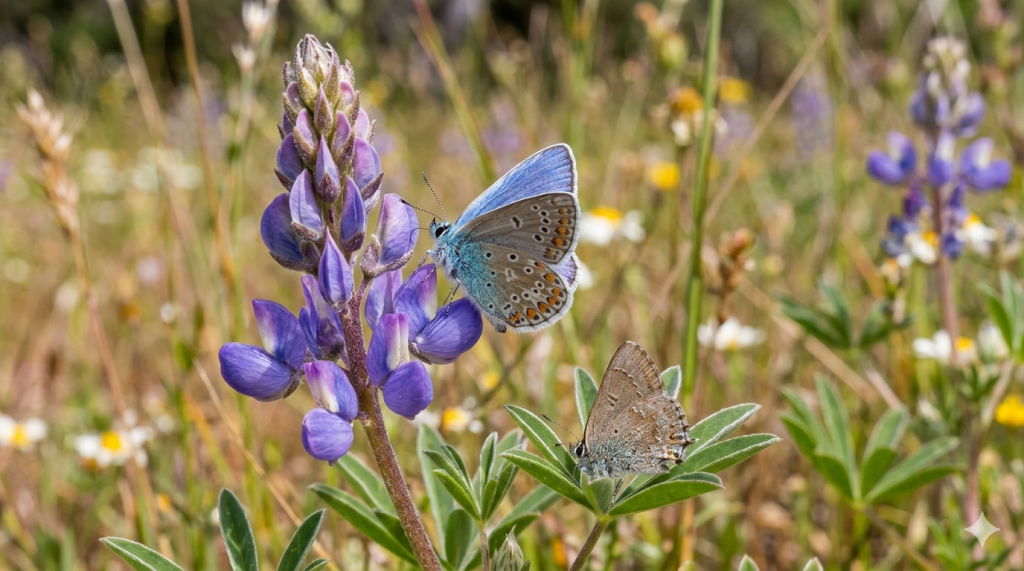
Karner Blue & Frosted Elfin Butterflies
Gone extinct
Canadian extinctions in the last 50 years.
While Canada hasn’t lost any high-profile megafauna like grizzly bears or caribou entirely to global extinction in the last 50 years, several unique, localized species and distinct populations have completely vanished from the country.
### 1. Globally Extinct
(Gone Forever)These unique creatures only existed in specific Canadian habitats and are now completely lost to the world: * **The Hadley Lake Sticklebacks (Extinct c. 1999):** This was a fascinating “species pair” (two distinct but closely related species, the Benthic and Limnetic sticklebacks) that lived side-by-side exclusively in Hadley Lake on Lasqueti Island, British Columbia. Discovered in the 1980s, they were entirely wiped out within a decade after someone illegally introduced predatory catfish into the lake. * **The Banff Longnose Dace (Extinct c. 1986):** This tiny, specialized freshwater fish was endemic to a single marsh fed by hot springs in Banff National Park, Alberta. A combination of factors led to its sudden demise: the introduction of invasive tropical aquarium fish, a beaver dam that restricted their movement, and chlorinated water leaking into the marsh from a nearby swimming pool.
### 2. Extirpated from Canada (Still Exist Elsewhere)
These species or distinct regional populations once thrived in Canada but can now only be found in the United States or in captive breeding programs: * **Greater Prairie-Chicken (Extirpated c. 1987):** Known for the striking, bright orange air sacs on the necks of males during their elaborate courtship dances, this large grouse once ranged across Alberta, Saskatchewan, Manitoba, and Ontario. Massive habitat loss from agriculture and over-hunting drove them completely out of Canada. * **Karner Blue & Frosted Elfin Butterflies (Extirpated c. 1991 and 1988):** Both of these small, beautiful butterflies disappeared from their native oak savannah habitats in southern Ontario. The Karner Blue vanished primarily because its caterpillars feed exclusively on wild lupine, a plant that rapidly disappeared due to land development and fire suppression. * **Black-Footed Ferret (Extirpated in the wild c. 1974):** This nocturnal predator disappeared from the Canadian prairies as its primary prey, the prairie dog, was systematically eradicated by ranchers. While technically extirpated from the wild decades ago, massive conservation efforts have since attempted to carefully reintroduce captive-bred ferrets back into Saskatchewan’s Grasslands National Park.
### 3. Recent Distinct Population Extinctions
The Committee on the Status of Endangered Wildlife in Canada (COSEWIC) also tracks distinct regional populations that disappear: * **Lake Whitefish Species Pairs (Como Lake, ON) (Extinct c. 2018):** A unique evolutionary pair of small- and large-bodied whitefish in Como Lake, Ontario, was officially declared extinct after an invasive zooplankton (the spiny waterflea) completely disrupted the local food web. * **Atlantic Walrus – Nova Scotia/Newfoundland Population (Extinct c. 2017):** While the Arctic populations of the Atlantic Walrus survive, the distinct population that once hauled out along the Atlantic coastlines of Quebec, New Brunswick, Nova Scotia, and Newfoundland was formally declared extinct by COSEWIC after failing to recover from historical commercial harvesting.



 Kevin Griffiths
 percypaschal
