


Elk and moose open September 10th and run through November accordingly to the jurisdiction or the area that it’s in.
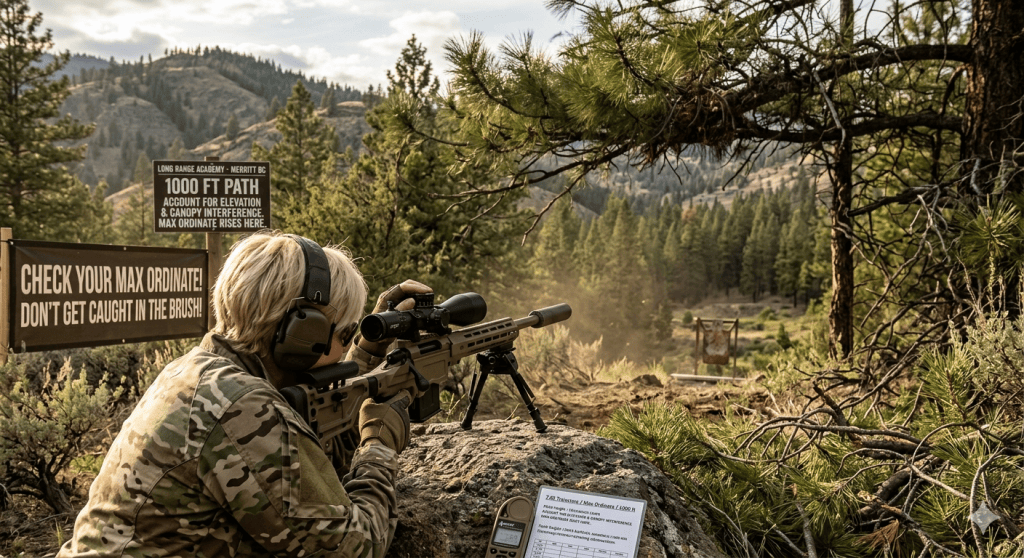
When a bullet is fired from a rifle, it doesn’t travel in a perfectly straight line; instead, it follows a parabolic trajectory called an **arc**. The moment the bullet leaves the muzzle, gravity begins pulling it downward, while atmospheric drag slows its forward velocity. To hit a target 1,000 feet away, the rifle barrel must be slightly elevated, forcing the bullet to climb to a **peak height** (known as the ordinate) before gravity coaxes it back down to the target’s level.Because different cartridges carry varying bullet weights and gunpowder capacities, their trajectories—and how high they must fly to cover that distance—differ significantly.Here is the typical peak height (maximum ordinate) for each caliber when zeroed for a 1,000-foot (approximately 333-yard) target:### **.30-Caliber / 7.62mm (e.g., .308 Winchester / 7.62x51mm NATO)** *
**Peak Height:**
Approximately **1.5 to 1.8 feet** (18 to 22 inches) above the line of sight. * **The Arc:** A standard 147-grain or 168-grain .30-caliber bullet leaves the barrel at around 2,600 to 2,800 feet per second. To hit a target 1,000 feet out, it reaches its highest point roughly 550 to 600 feet downrange, coasting just under two feet higher than your point of aim before dropping back down.### **.50-Caliber (.50 BMG)** * **Peak Height:** Approximately **1.0 to 1.2 feet** (12 to 14 inches) above the line of sight. *
**The Arc:
*The massive 647-grain to 750-grain .50-caliber bullet travels at a similar muzzle velocity (around 2,700 to 2,800 feet per second) as the .30-caliber, but its immense weight gives it a much higher ballistic coefficient. It retains its velocity incredibly well and cuts through air resistance effortlessly, resulting in a noticeably flatter trajectory and a lower peak height over a 1,000-foot distance.Are you looking at these trajectories for a specific ballistics project, or perhaps a scene you are writing?
Line of sight
Yes, your shot can absolutely be spoiled by interference above the line of sight. This is a classic hazard for hunters, target shooters, and tactical marksmen alike.Because a shooter looks through a scope or iron sights in a perfectly straight line, they only see the **line of sight**. They cannot see the actual, curved **line of departure** (the arc the bullet takes).Here is how that arc can cause unexpected trouble when dealing with overhead obstacles:
### The “Hidden”
Whenyou are aiming at a target 1,000 feet away, you might have a perfectly clear view of the target through your optics. However, because a .30-caliber bullet loops up to nearly 2 feet above that straight line of sight, any low-hanging tree branches, thick brush, or structural ceilings (like the roof of a shooting pavilion or a cave opening) sitting within that upper window can intercept the bullet.### What Happens Upon ImpactIf the bullet nicks a branch or brush at the peak of its arc, a few things happen instantly:
* **Deflection:
*Even a tiny twig can drastically alter the bullet’s flight path, sending it feet wide or high of the target by the time it travels the remaining distance. * **Tumbling and Deformity:** Hitting an object causes the bullet to lose its aerodynamic stability. It will begin to tumble, lose velocity rapidly, and shed accuracy. * **Fragmentation:** Depending on the bullet type (especially softer hunting rounds), hitting an obstacle mid-flight can cause it to break apart prematurely.### The Proximity FactorWhere the brush is located along that 1,000-foot path matters immensely: * **Near the muzzle:** The bullet is still rising quickly. Obstacles just above your line of sight close to you are a high risk. * **At the mid-point (500–600 feet):** This is where the bullet reaches its **maximum ordinate** (its highest point). This is the danger zone for low-hanging ceilings or tree canopies that look perfectly clear through your scope.
* **Near the target:
** The bullet is on its descent, meaning obstacles lower to the ground near the target become the primary threat.In short, just because you can see the target doesn’t mean the bullet has a clear path to get there. Marksmen always have to account for that invisible “loop” in the zone above their crosshairs.
Ed Hendricks, Ponderosa Sports Merritt
Moose and Elk season opens September 10th 2026. Please be careful for each other. Follow regulations and local experts such as the is Ponderosa’s Sport shop?
Merritt is a fishing destination,
Editors Note:PP
One of the sure things, and because it’s illegal and dumb, never shoot a rifle across water.



 Kevin Griffiths
 percypaschal
