

Category: Arts and Culture


Happy New Years 2015

Toast the future, and remember your friends...

Happy New Years, long, long ago and for sake of those that have gone, enjoy the year coming to you!

New years swim

The Nicola Valley Aquatic Center is having a new years eve ( after noon swim.) The swim will be on December 31st from 1 -3 PM at he facility on Mamette avenue in Merritt.
There is no charge for the swim and the pool is in walking proximity to 5 EV charging stations some of which take 2 hours to recharge an EV.

Today in history,December 30th 1948

The Tony award winning Kiss me Kate opens at the Cole Porter theater.

White Christmas

Mountain ash Tree native of England Photo KDG

Mountain ash Tree native of England
Photo KDG

Have a Great Holiday look forward to serving you in the new year.
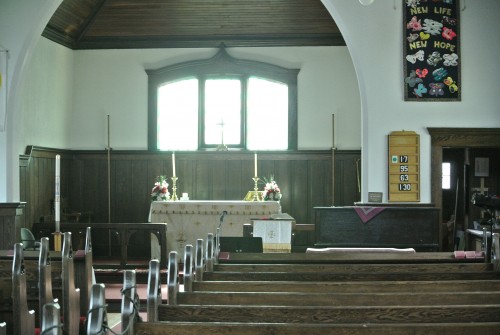
TGIF Six days to Christmas


Anglican church interior, Merritt BC

Anglican church interior, Merritt BC

Think about visiting a faith community this holiday season.


Today in history: December 19th 2001
Record barometric pressure of 1085.6 is recorded in Mongolia.

$1.09.9 a liter

The Petro Canada is showing an offering of 1.09 a liter for regular gasoline at the pumping station at the junction of Highway 8 and 5A. There has been a dramatic drop in prices at the pumps in the last few weeks coming from mid $1.30 a liter to todays low. Petro Canada also offers a loyalty card program that gives you another 12 cents a liter making it possible to get regular gasoline at under the dollar a liter range. The CIBC is reporting that Canada has lost 5 billion in revenue in the recent drop in prices. We take that as lost revenue from exports. To balance the net benefit of lower gas prices to the consumer we must assume that a drop in price is a more broadly fare benefit to more people domestically then lost export revenue. Today in History: December 17th 1935 The DC-3 aircraft makes its first flight.  

Playing devils advocate

Taking a position for the sake of argument has been a useful and productive method to improve an end result of a doctrine, law, or statement. We have been involved in taking the status quo position in debates and find it a little uncomfortable and difficult. We can imagine that in an opposition in government if you played devils advocate with out a conviction its merit you could be stained be the perception that you have poor alternative to the movement.

In common parlance, a devil’s advocate is someone who, given a certain argument, takes a position they do not necessarily agree with (or simply an alternative position from the accepted norm), for the sake of debate or to explore the thought further. In taking this position, the individual taking on the devil’s advocate role seeks to engage others in an argumentative discussion process. The purpose of such a process is typically to test the quality of the original argument and identify weaknesses in its structure, and to use such information to either improve or abandon the original, opposing position. It can also refer to someone who takes a stance that is seen as unpopular or unconventional, but is actually another way of arguing a much more conventional stance. The background of this word comes from an official position within the Catholic Church, in which a canon lawyer called the Devil’s Advocate, also known as the Promoter of Faith, “argued against the canonization (sainthood) of a candidate in order to uncover any character flaws or misrepresentation evidence favoring canonization.”[1]

Discussion is always better then unilateral action. Compromise amongst people of good faith is desirable in most all situations.
Taking the position late in a debate can put you in the place of folding the tent up for those that have done the lions share of work and may cause some resentment, however if serious error is prevented it may be the right thing to do.

Today in history: December 16th 1707
The last recorded eruption of Mount Fuji in Japan.

Free trade has been a world opener for us in Canada however it has also brought with it a lot of unpleasentness that we Canadians could have avoided. If it is not possible to get cooperation then perhaps a tarriff regime is once again the best course for Canada. PR

Compare and contrast.

Prime Minister Stephen Harper, recently in the House of Commons:

“Frankly, Mr. Speaker, under the current circumstances of the oil and gas sector, it would be crazy, it would be crazy economic policy to do unilateral penalties on that sector. We’re clearly not going to do that,” Harper told the House as Conservative MPs roared their approval.
“In fact, nobody in the world is regulating their oil and gas sector. I’d be delighted if they did. Canada will be there with them.”

Jim Prentice, then federal minister of the environment, not quite five years ago:

“For those of you who doubt that the government of Canada lacks either the willingness or the authority to protect our national interests as a ‘clean energy superpower,’ think again,” he warned darkly. “We do and we will. And, in our efforts, we will expect and we will secure the co-operation of those private interests which are developing the oil sands. Consider it a responsibility that accompanies the right to develop these valuable Canadian resources.”

Back then, it was possible to believe the federal government would impose regulations on the oil and gas industries. The government certainly said it would, often enough. (Peter Kent in February, 2013: “We are now well into, and very close to finalizing, regulations for the oil and gas sector.”) But, as Chris Turner reminds us in his book The War on Science, Prentice quit as environment minister in November 2010, and the Harper government’s periodic attempts to demonstrate environmental virtue, even at some hypothetical cost to the resource sector, pretty much came to an end.

Of course, it can be hard to tell where the notion of oil and gas regulations ended. Prentice himself has been sounding much like Harper since he became premier of Alberta:

“Environmental performance is important, but so, too, is our industrial competitiveness . . . I think this low-price environment is a reminder . . . that we have to be careful laying on costs, including regulatory costs, on our industry, because we need to remain competitive.”

But is even that new? From my 2010 article, linked above:

“We will only adopt a cap-and-trade regime if the United States signals that it wants to do the same. Our position on harmonization applies equally to regulation. Canada can go down either road—cap and trade or regulation—but we will go down neither road alone.”

So the paper trail on the government’s oil and gas policy is a bit of a mess. The feds will only impose regulations in concert with the Americans? Well, there are two problems with that story. First, as Bruce Cheadle points out:

An Environment Canada briefing memo revealed last month by the Globe and Mail shows that the United States, in fact, placed what were called “significant” limits on its oil and gas sector in 2012.

“For oil and gas, recent air pollution regulations are expected to result in significant greenhouse-gas reduction co-benefits, comparable to the reductions that would result from the approach being developed for this sector in Canada,” states the June 2013 memo obtained by Greenpeace under an Access to Information request.

Mcleans
Yep!
Today in history: December 12 1911
Deli replaces Calcutta as the Capital of India.

Out door rink

lacrosse rink nearing completion. Photo KDG

Lacrosse rink nearing completion. Photo KDG

The Lacrosse rink on Voght street is taking form with red and blue lines marked and back boards going up. The rink will be having overhead lighting before being completed sometime in January 2015
Today in History: December 10 th 1901
The first Nobel Peace Prize is awarded.

Twinning the line

The Pipeline filed their submission a year ago and our experience with the operators of the line over the last 60 years has been good , they have been presenting the economic benefits of the line. A copy of the filed submissions is in the quote below, remember these are construction jobs and benefits to most interested while there was a boom here with the first line it worked out to one permanent employee here then automation took that one away. Construction crews are often moved from project to project but the wise would lobby for lasting jobs by offering what it takes to attract either construction workers or maintenance people with amenities.

On December 16, 2013, Trans Mountain filed a Facilities Application for the Trans Mountain Expansion Project. This webpage is not intended as a substitute for the actual content of the submission. Volume 2 of the Application provides a full description of the Project. To view all eight volumes of the Application, click here. As the world’s third-largest oil producer, Canada benefits greatly from the export of national resources. Twinning the Trans Mountain Pipeline will increase Canada’s capacity to export these resources by facilitating the movement of oil to the West Coast for marine transport to market. It will further secure the supply of oil products to the Lower Mainland for use by BC’s residents and businesses. The project will also lead to new jobs in the short and long term, job-related training opportunities, and increases in taxes collected through all three levels of government. The $5.4 billion pipeline project will increase the value of Canadian oil by unlocking access to world markets. The combined minimum fiscal impact for construction and the first 20 years of expanded operations is $18.5 billion including federal, provincial and municipal tax payments that can be used for public services such as health care and education. British Columbia receives $2.1 billion; Alberta receives $9.6 billion, and the rest of Canada shares $6.8 billion. Municipal tax payments (not adjusted for inflation) total $922 million to BC and $124 million to Alberta over the first 20 years of expanded pipeline operations. Direct capital spending for the construction phase of the project includes $3.8 billion to British Columbia and $1.6 billion to Alberta. At the peak of construction, 4,500 people will be working on the pipeline expansion. The expansion will also create approximately 3,000 direct, indirect and induced jobs per year during operations. Overall the Project generates a minimum of 108,301 direct, indirect and induced person-years of employment during project development and operations. British Columbia’s share is 66,132 person-years including 35,864 during project development and 30,269 during operations. Alberta’s share is 24,926 person-years including 14,632 during project development and 10,293 during project operations.

Good luck to all that want a live an livelihood and peace to enjoy it.KDG
Today in History: December 9th 1962
The  Petrified Forest National Park is established in Arizona.

TGIF-NVISA new roof

The Nicola Valley Indian Administration building is getting a new roof. The building build in 1971 is at the corner of Garcia and Coutlee, in down town Merritt. Tom Tar Roofing and Sheet metal no address on the door is doing the work and crews have worked all week in – double-digit weather to do the job. The Indian administration administers for 6 bands in the valley and has put together corporations to hold businesses in partnership including the Days INN ( destroyed in a fire several years ago). The Indians of the Nicola valley are considered progress by many including attitudes toward addiction and self-improvement.

Today in history: December 5th 63 BC
Cicero gives his last discourse on warfare.

The people that are proposing the twinning of the pipeline through here are having a job opportunity meeting tonight at the Merritt Civic Center.Drop in starts at 5:30 PM the presentation starts a 6:30 PM.

Trans Mountain Pipelines have operated a pipeline to Burnaby from Edmonton Alberta for 60 years without serious incident.
The Merritt Civic Center is on Mamette avenue behind city hall on Voght Street.

Today in History: December 4th 1909
The first Canadian Grey cup game is played.
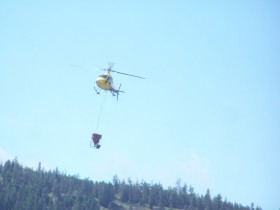
Over head work

Helicopters doing work can be an overhead hazard File photo KDG

Helicopters doing work can be an overhead hazard
File photo KDG

The 130 KV transmission line from Merritt to the Highland Valley is under way. A legal notice from BC Hydro put in the local paper says that helicopters will be stringing rope lines for the line for less then a week and be finished by mid December. Sources say that the line is a two wooded pole “H style” construction.

The project is slated to finish in 2015.

Today in History: December 2nd 1970, December 3rd 1997