You are presumed to be honest and responsible without evidence to the contrary beyond a reasonable doubt… on the balance of probablilties you are justified by 51 % likelyhood.
The trust is gone and we should not continue thinking in terms of rationalizing our good will as being tangible barter in new trade relations. After an arbitrary and vicious attack we cannot say well we will taste good going down the US administration’s gulet; will that make it better for you Mr.wolf.
Good job Daniel…
US: Administration
PS: we are not dealing with the same personage from the first administration but personage has been added or subtracted, to our disadvantage…
Pragmatic strength must prevail for us and we must resist niceness as appeasement. Too many of our people have been blindsided.
Peace and security was on the table for consideration over the last week.
Easter celebrations gave hope for traditional renewal in spring rites, the death of a Pope reminded us of the limits of our opportunities in our own lives to make a difference, to spend some time and enjoyment and to spread whatever goodness we find in ourselves to others.
Earth day yawned a wink at us as clocks ran on. History blew a wisp of what was and is and is to come.
And you my friend, you gave me the opportunity to share another day.
Five defendants all represented by separate lawyers
No American Style jury selection process.
Jurors can be removed for cause.
Vigorous defence to come “CBC”
Expected to last into June.
Editor’s note
Criminal convictions could and do lead into civil actions on noncriminal culpable reveals. ie: associations for misconduct that led to:
Non criminal negligence leading to opportunity.
Stay relevant stay just. Boys will be boys and raised to adult sanctions to make a point… For the rest of the world to note… Still presumed as innocent until…
How to avoid a case pupl eek
People should pay a measure of attention to the justice system, however the same constrains on the court should apply, presumption, and relevancy need to be respected.
In British Columbia, the climate of work conditions for nurses, ambulance staff, and medical practitioners is marked by both challenges and advancements. The increasing demand for healthcare services due to an aging population has led to high workloads, which can result in burnout and stress among staff. Additionally, issues like staffing shortages and long hours often exacerbate these conditions. However, there have been efforts to improve work environments, including better support systems, competitive salaries, and enhanced mental health resources. The province is also investing in technology and training opportunities to streamline processes and improve patient care, aiming to create a more sustainable and supportive workplace for healthcare professionals. Overall, while the healthcare sector faces significant pressures, ongoing initiatives are working towards a more positive and resilient workforce.
Not only health care but all engagement of public has risk.
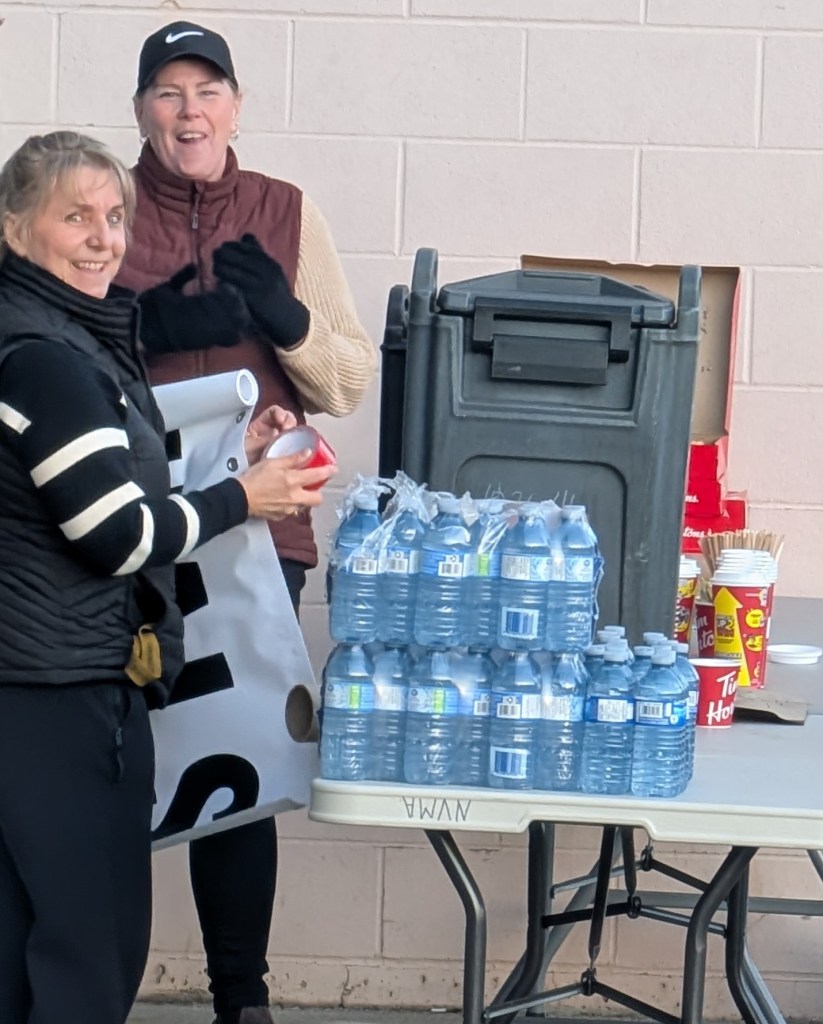
These two people were meeting the public outside a hockey game. There’s always a risk when you meet the public that somebody is a little off. Be careful. Be aware and don’t be vulnerable.
What to do…(Never deny someone’s feelings). And…
Dealing with potentially volatile individuals requires a careful balance of de-escalation tactics and safety awareness. Here’s a breakdown of strategies to help you navigate such situations: Disarming Techniques: * Maintain Calm and Respect: * Speak in a calm, even tone. Avoid raising your voice or displaying aggressive body language. * Show respect, even if you don’t agree with the person’s behavior. Acknowledge their feelings without necessarily validating their actions. * Use open and non-threatening body language. Keep your hands visible and avoid crossing your arms. * Active Listening: * Pay attention to what the person is saying. Let them vent without interrupting excessively. * Use reflective listening, which involves summarizing and restating what they’ve said to show that you understand. * Empathy can be a great tool. Try to see things from their perspective, even if you don’t agree. * De-escalation Strategies: * Create space. Give the person physical space. Avoid crowding them. * Redirect their focus. Try to shift the conversation to a neutral topic or offer a solution. * Avoid arguing or contradicting. Instead, use phrases like, “I understand,” or “I can see how that would be frustrating.” * Offer choices, when possible, to give them a sense of control. * Verbal Judo: * This technique emphasizes using words to redirect behavior. * Start by introducing yourself and explaining your role. * Ask open-ended questions to encourage them to talk. * Use persuasive language to gain their cooperation. Safety Measures: * Situational Awareness: * Be aware of your surroundings and identify potential escape routes. * Notice any signs of escalating aggression, such as clenched fists, raised voices, or rapid breathing. * Trust your instincts. If a situation feels unsafe, remove yourself from it. * Set Boundaries: * Clearly communicate your boundaries. Let the person know what behavior is unacceptable. * Be firm but polite. * If their behavior continues, be prepared to disengage. * Prioritize Your Safety: * Your safety is paramount. Do not hesitate to remove yourself from a dangerous situation. * If you feel threatened, call for help. * If possible, position yourself so you have an escape route. * If you are able to, and feel it is needed, remove yourself from the area. * Documentation: * If possible, and if it is safe to do so, document any interactions that made you feel unsafe. This can be helpful if you need to report the incident. Important Considerations: * People who are upset or abusive may be experiencing mental health issues or substance abuse. * These strategies are not foolproof. Some individuals may be beyond reason. * It’s crucial to prioritize your safety and seek help when necessary. By combining disarming techniques with safety precautions, you can increase your ability to navigate challenging interactions and minimize the risk of harm.
So, here’s a little critter of a word that you need to be careful with and using business. You should always be careful when you were attributing any of these things agency or whatever that it really reflects who the person really needing the credit for.
Multiple functions
The word “by” serves multiple functions in the English language, primarily as a preposition. It is commonly used to indicate:
Agency: Who or what performs an action (e.g., “The book was written by the author.”)
Means: The method or tool used (e.g., “She traveled by train.”)
Proximity: Physical closeness (e.g., “The park is by the river.”)
Time: A deadline or point in time (e.g., “Please submit the report by Monday.”)
Manner: The way in which something is done (e.g., “He solved the problem by using a new strategy.”)
To apply “by” in a proper way for equitable results, consider the following tips:
Clarity: Use “by” to clearly specify who is responsible for actions or decisions to promote accountability.
Transparency: When describing processes, use “by” to explain how decisions were made or actions were taken, fostering an understanding and trust.
Inclusivity: When discussing methods or means that involve various stakeholders, phrase your sentences to highlight collective contributions (e.g., “We achieved our goal by collaborating with all team members.”)
Setting Timelines: Use “by” effectively to communicate deadlines, ensuring that all parties are aware and can meet expectations without ambiguity.
Applying these guidelines will lead to more equitable communication and collaboration, enhancing understanding and cooperation among involved parties.
I’m
Using “I’m” in business communication can convey personal connection and sincerity, but clarity and tone are crucial. Here are some points to consider:
Clarity
Be Specific: When using “I’m,” clearly state your thoughts or feelings to avoid ambiguity (e.g., “I’m excited about the upcoming project” instead of “I’m looking forward to it.”)
Context Matters: Ensure that the context of the message allows for personal expressions. It should match the formality of the situation.
Emotional Impact
Balance Emotion with Professionalism: While expressing emotions can build rapport, it’s important to strike a balance. Overly emotional statements may undermine professionalism (e.g., “I’m passionate about this initiative” is appropriate; “I’m emotionally invested” could feel too personal).
Usage in Business Mail
Appropriate Settings: Use “I’m” when fostering relationships or when personal engagement enhances the message. It can be suitable in less formal communications or when establishing common ground.
Avoid in Formal Situations: In very formal or transactional communications, it might be better to use more neutral language (e.g., “We are committed to achieving our goals”) to maintain professionalism.
In summary, using “I’m” can be effective if done thoughtfully, ensuring that your communication remains clear and appropriate for the context.
Excellence
Byword
To be referred to as a “byword” means to be: * A perfect or proverbial example of something: * If someone is a “byword for generosity,” they are incredibly well-known for their generosity. * A place could be a “byword for luxury” if it’s famously opulent. * An object of scorn or derision: * If a company is a “byword for poor customer service,” it’s notorious for having bad customer service. Essentially, a byword is a word or phrase that has become strongly associated with a particular person, place, or thing, often in a way that summarizes their defining characteristic.
Canadians should be: Tough on what could be “continued Vasseliseing”! Opinion.
Editor’s Note:
There is Merit in the problems and the solutions are in reach. No panic, application mutes action when settled. Always keep the conversation going and civil.
You are not a magician. You’ve got to rely on you and your others. And you don’t want to be a burden on anybody, including yourself. Make plans. Years are coming. Decades are flying. Centuries are looming. + You don’t want to miss a thing.
No, if you mean do I respond well to the poor character. Traps of engagement are a source of the aggravation of the soul that we suffer. Seemingly endless time talent and virtue is wasted in a well-meaning dance of passive argument. Then a posturing to defences involved in recruitment to less than acceptable character traits.
Recreate a delusion
Like an evangelist preaching to the converted there’s a sense of it’s just my image of the character absolute that is a struggle for all.
Judge Character
Forget that. React where it’s your business and contracting in a way that protects you first. So as not to be in the position of dependency on a bad character or a person that you’re going to make a bad character be by being slothful.
As the year draws to an end, it’s not unusual to hear questions like, “What are you leaving behind in 2024?” We’ve all had our fair share of experiences, and let’s be honest—there’s definitely some weight we need to shed before stepping into the new year. A few years ago, there was this craze: “Let […]












 Kevin Griffiths
 percypaschal
 The Proprietor Review