
The Flat Earth Society has a fascinating and somewhat convoluted history! Here’s a breakdown of its beginnings, people, purpose, revivals, and related cultural aspects:
Beginnings and People
The modern Flat Earth movement gained traction with Samuel Rowbotham in the 19th century, who published “Zetetic Astronomy” in 1849, arguing for a flat Earth based on his Bedford Level experiment. He also founded a “Zetetic Society.”
The organization most commonly recognized as “The Flat Earth Society” was formally established in 1956 by Samuel Shenton in Dover, England, as the International Flat Earth Research Society. Shenton, surprisingly, was a Fellow of both the Royal Astronomical Society and the Royal Geographic Society. He believed his theory was rooted in common sense and lacked sufficient counter-proof from scientists.
After Shenton’s death in 1971, Charles Johnson took over, moving the headquarters to California. Johnson was a fervent believer, claiming a conspiracy against the flat Earth theory and asserting that the Sun and Moon were flat discs much closer to Earth. He also rejected the 1969 Moon landing as a hoax. The society’s philosophy under Johnson often drew from literal interpretations of the Bible. The society’s membership declined in the 1990s and effectively ended with Johnson’s passing in 2001.
The Flat Earth Society of Canada
Separately, the Flat Earth Society of Canada was founded on November 8, 1970, in Fredericton, New Brunswick, by philosopher Leo Ferrari, writer Raymond Fraser, and poet Alden Nowlan. Their aims differed somewhat from other flat Earth societies. They called themselves “planoterrestrialists” and aimed to challenge people’s willingness to accept theories on “blind faith” and to reject the evidence of their own senses. Their intention was largely parodic, using the flat Earth concept to promote critical thinking and media literacy. Leo Ferrari was a prominent figure, often appearing in media to promote their ideas, including a mockumentary where he was “outed” as a “globularist.” The Canadian society was active until 1984.
Purpose
The core purpose of the Flat Earth Society (International) has been to advocate for the belief that the Earth is flat, often drawing upon pseudoscientific claims, interpretations of religious texts (particularly the Bible), and conspiracy theories. They contend that gravity is an illusion and that Antarctica acts as an icy barrier surrounding the Earth. They aim to “oppose theoretical dogmatic assumptions” and restore confidence in “the validity of human perceptions.”
The Flat Earth Society of Canada, as mentioned, had a more nuanced, often parodic purpose: to encourage critical thinking by disputing a widely accepted scientific fact, highlighting how people can accept things on “blind faith.”
Revival
The International Flat Earth Research Society, after its decline in the 1990s, saw a revival in the early 2000s, particularly around 2009, largely due to the rising influence of the internet and social media. This new wave of interest has led to annual conferences and a global reach.
The Flat Earth Society of Canada was also “re-created” as an art project in 2003 by artist Kay Burns through her alter ego, Dr. Iris Taylor, leading to the creation of the Museum of the Flat Earth.
Museum
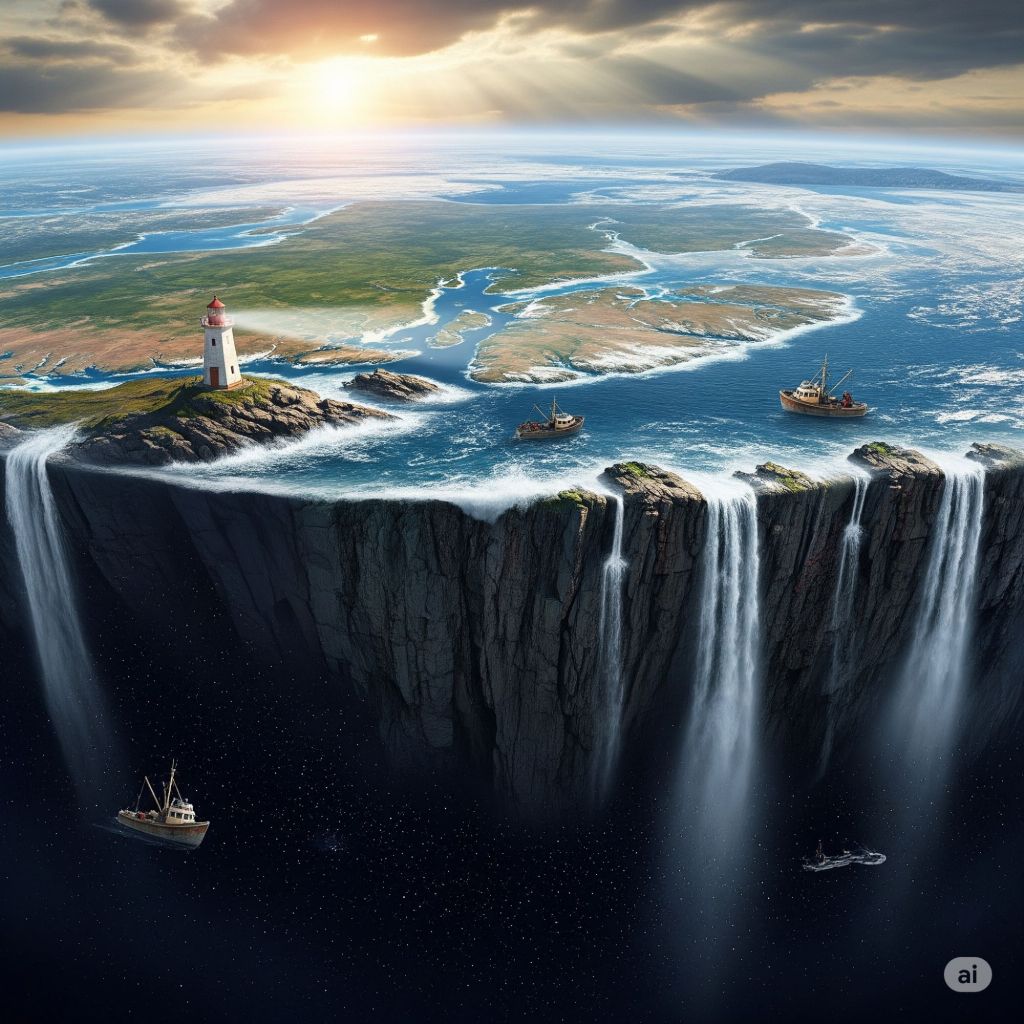
Yes, there is a Museum of the Flat Earth! It formally opened in May 2016 on Fogo Island, Newfoundland, Canada. This small museum is dedicated to the history of the Canadian Flat Earth Society, featuring historical collections related to the original 1970s group, personal effects of Bartholomew Seeker (a notable figure associated with the Canadian society who relocated to Fogo Island as the “guardian of the corner”), and contemporary displays addressing flat Earth debates. The museum is located in Shoal Bay and also includes a coffee bar and shop. Fogo Island is significant because Brimstone Head, a prominent geological feature there, has been labeled as one of the “corners of the Flat Earth.”
Songs and Tourist Attractions
While there isn’t a widely recognized official anthem or extensive catalog of “Flat Earth Society” songs, the concept has certainly inspired musical artists. For example, the Canadian band Barenaked Ladies released a song titled “Flat Earth” on their album “Detour de Force” (2021). There’s also a Belgian big-band jazz group called “Flat Earth Society” (FES) that has released albums since the late 1990s. During Canada’s first-ever Flat Earth Conference in West Edmonton Mall, one attendee, Rick Hummer (as his alter-ego Rolan Reedy), performed a flat Earth-inspired rendition of “Brown Eyed Girl.”
As for tourist attractions, the most prominent is the Museum of the Flat Earth on Fogo Island, Newfoundland, Canada. Visitors can also experience Brimstone Head on Fogo Island, often referred to as one of the “four corners of the Earth” by flat Earth proponents. The area also hosts the Brimstone Head Folk Festival, and the Fogo Island Inn offers world-class accommodations, making it a unique destination with a connection to the flat Earth narrative.
It’s clear that while the Flat Earth Society as a serious organization has seen its ups and downs, the concept itself continues to capture public imagination, sometimes for genuine belief and other times for artistic and critical inquiry.


 Kevin Griffiths
 percypaschal
 The Proprietor Review