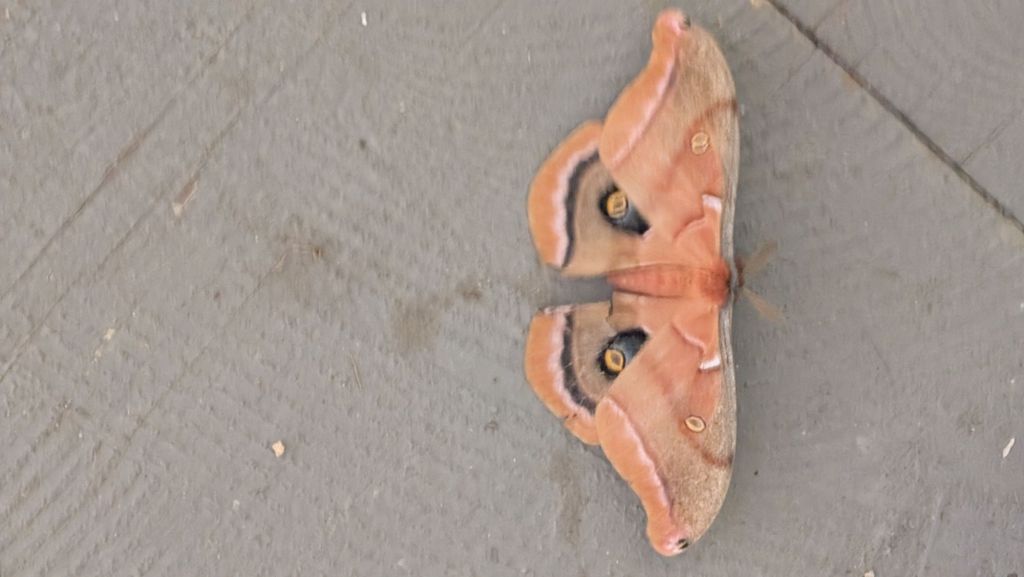
No Mouth lives a Week

Àntheraea Polyhemus moth, Photo KDG

Merritt BC,CA

At the height of the smoke infested Nicola Valley this month appeared on the third floor on my walkway into my apartment.

This moth has no mouth and only lives a week. Some of the fire conditions that were out there when I found this thing. I took the picture and I moved a little closer and it flew away on it. So in power I guess time is very important to edit this point. But it’s alignment I have to. You know ask and maybe ignorantly ask that if conditions were right for this thing to be out and about and only had a week to live and to reproduce. And what does that say about the fires and the natural ecology of fire?.
The Polyphemus moth (Antheraea polyphemus) is one of North America’s largest and most striking giant silkworm moths. Named after Polyphemus, the Cyclops from Greek mythology, it gets its name from the large, translucent, eye-like spots on its hindwings that serve as a defense mechanism to startle potential predators.
Geographic Range
The Polyphemus moth has an exceptionally broad distribution across North America.
* Reach: Found extensively across all 10 Canadian provinces and virtually the entire contiguous United States, extending south into central Mexico.
* Exceptions: It is absent from extreme northern regions (Alaska and far-northern Canadian territories) and arid desert regions in the American Southwest (such as Nevada and parts of Arizona), as well as Hawaii.
* Habitat: Deciduous forests, suburban parks, orchards, and rural woodlands where host trees like oak, birch, maple, and willow are plentiful.
Lack of Mouthparts & Impact on Lifespan
Like other members of the Saturniidae (giant silkworm) family, adult Polyphemus moths have vestigial mouthparts.
* No Feeding or Hydration: Their functional proboscis (mouthpart) and digestive tract are entirely absent or reduced to non-functional remnants. They cannot eat, bite, or even drink water.
* Impact on Adult Lifespan: Because they cannot ingest energy, the adult moth’s life is a ticking clock. Adults live only 4 to 7 days on average (rarely up to 10–14 days in cool conditions).
* Biological Purpose: The adult phase exists solely for reproduction. Every action is powered entirely by the energy reserves stored as lipids and fats during the caterpillar stage. Males fly continuously at night searching for female pheromones, while females conserve energy by remaining mostly stationary until mated.
Total Lifespan
While the adult phase is ephemeral, the total life cycle spans roughly 3 months to 1 year, depending on climate and diapause:
| Stage | Duration | Primary Activity |
|—|—|—|
| Egg | 10 to 14 days | Incubation on host leaves |
| Larva (Caterpillar) | 5 to 6 weeks | Heavy feeding through 5 instar stages |
| Pupa (Cocoon) | 2 to 3 weeks (or 8+ months if overwintering) | Metamorphosis inside silk shell |
| Adult Moth | 4 to 7 days | Mating and egg-laying |
Dormancies & Generations (Voltinism)
The Polyphemus moth manages harsh winters and regional climates through diapause (a dormant state during the pupal stage inside its silken cocoon).
* The Cocoon: In late summer or autumn, the mature green caterpillar wraps a host tree leaf around itself and constructs a tough, oval silk cocoon. When leaves fall in autumn, many cocoons drop to the forest floor to hibernate in the leaf litter, though some remain anchored on branches.
* Overwintering Diapause: As daylight shortens and temperatures drop, the pupa enters a hormonal state of suspended animation. It stays dormant throughout the freezing winter months and only re-activates when spring temperatures consistently warm up.
* Regional Generations (Voltinism):
   * Northern Regions (e.g., Canada, Northern US): Uni-voltine (one generation per year). Adults emerge in early summer (May–July), lay eggs, and their offspring pupate in late summer to sleep through the winter.
   * Central/Southern Regions: Bi-voltine or multi-voltine (2 to 3 generations per year). Early summer adults lay eggs that produce a second summer brood without diapause. Only the late-autumn generation enters winter dormancy.
Life span