
Context: National day of morning for injured and killed in accidents.
Pedestrian deaths in Canada.
On This day of morning,we consider those lost in pedestrian 🚸 actions. On average 300. Pur anum
Welcome, and thank you for seeking clarification on safe street crossing practices and the crucial (and often misunderstood) bylaw regarding a pedestrian’s lack of right of way. Crossing the street safely is a fundamental life skill that, when performed correctly, ensures the smooth flow of traffic and, most importantly, protects you from harm.Let’s dive into the specifics, starting with the bylaws and then expanding on the physical act of crossing.###
Part 1: Deciphering the Right of Way Bylaw
The concept of ‘right of way’ is the cornerstone of traffic safety, but its application can be nuanced. Many municipalities have specific bylaws regarding where and when pedestrians *lose* their right of way. It’s important to research the exact laws of your city or region, as terminology (like “jaywalking”) varies, but here is a detailed, general overview of the critical distinction:####
The General Rule
Generally speaking, when you are in a **designated crosswalk** (whether marked with white lines or unmarked at a T-intersection, 3-way, or 4-way intersection), and **traffic is required to stop for you,** you have the right of way once you have stepped into that crossing.####
The “Between Intersections” Bylaw
(Where You Do Not Have Right of Way)This is the rule that often trips people up and can lead to dangerous situations and tickets.**The core concept is this: In most urban and suburban areas, pedestrians are prohibited from crossing a street anywhere *between* intersections, and if they do so, they must yield to all vehicular traffic.**Think of it this way:
* **Intersection to Intersection:**
This is the segment of road between two legal crossing points. * **The No-Go Zone:** This entire middle section is where vehicles are travelling and generally do not expect pedestrians to be crossing.**Why does this bylaw exist?**This bylaw isn’t meant to make your walk inconvenient; it’s about predictability.
1. **Driver Expectations:**
Drivers are trained to look for pedestrians at intersections and crosswalks. They are *not* expecting someone to step out from behind a parked car or dart across the middle of the road.
2. **Speed:**
Vehicles are often travelling at higher, consistent speeds between intersections. This reduces their stopping distance and significantly increases the severity of an impact.
3. **Visibility:**
Parked cars, delivery trucks, and even trees can obstruct a driver’s view of someone trying to cross mid-block.**The Implications for You** * **NO RIGHT OF WAY:** When you cross between intersections, **all traffic has the absolute right of way.** This means vehicles are *not required to stop* for you, and it is your responsibility to ensure the way is completely clear. * **Liability:** If you cross mid-block, fail to yield, and get hit by a vehicle, you are likely to be found at fault (or partially at fault) for the accident, which has massive legal, medical, and financial consequences. * **Tickets:** In many places, “crossing where prohibited” is a fineable traffic offense.
### Part 2:
How to Safely Cross the Street
Now that we understand the legal landscape, let’s explore the physical, step-by-step process of safely crossing a street. These steps apply whether you are at a marked crosswalk or an intersection, but they are absolutely non-negotiable if you are forced (or choose, despite the rules) to cross elsewhere.####
1. Preparation and Location *
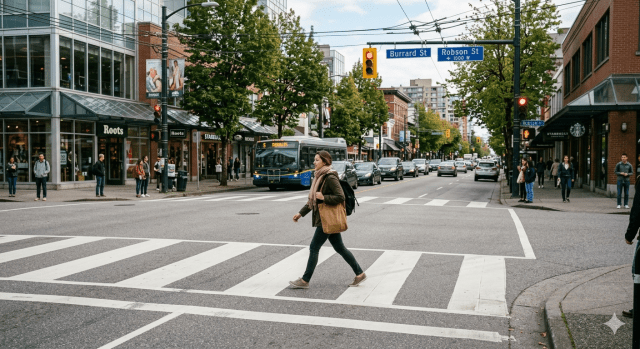
**Always Cross at Corners or Crosswalks:** This is the gold standard. Use a marked crosswalk (with the white ‘Zebra stripes’) or a legal, unmarked intersection crossing. Look for intersections with traffic lights or “Pedestrian Crossing” signs. * **Utilize Crosswalk Buttons:** If the crosswalk has a button (actuator), PRESS IT. This triggers the signal cycle to include your crossing time and alerts drivers that a pedestrian is waiting.####
2. The Golden Rule:
Stop, Look, and Listen
This isn’t just for children; it is the single most important safety protocol. * **STOP at the Curb (Not in the Road):** Always come to a complete stop on the sidewalk or shoulder before entering the roadway. Do not wait with one foot already on the asphalt. * **LOOK Both Ways (Repeatedly):** Look left, then right, then left *again* before you even consider stepping out. Why “left again”? Because in countries that drive on the right side of the road (like Canada), the traffic closest to you is coming from your left. A lot can change in the 3 seconds it takes to look right. * **LOOK for Turning Vehicles:** Don’t just look straight down the street. Check all corners of the intersection for cars making right or left turns. Many pedestrian incidents occur when a vehicle turns into a crossing pedestrian because the driver was focused on other cars and not people.
* **LISTEN:**
Traffic noise can sometimes give you warnings before you see a car. Electric vehicles are quiet, so this is especially important now. Turn down any loud music and remove earbuds if you need to be acutely aware of your surroundings.####
3. Establish Eye Contact
This is your safety confirmation. * **Do Not Assume a Driver Sees You:** Even if a car is slowing down, or even if it has stopped, do not assume they know you are there. * **Look at the Driver:** Look for the driver’s eyes. Wave at them or give a nod. Wait for them to acknowledge you—either by a wave, a nod, or a clear, complete stop. * **Only Proceed After Confirmation:** If you cannot make eye contact (e.g., heavily tinted windows), proceed with extreme caution, or, better yet, wait for another car.####
4. The Crossing
* **Walk, Do Not Run:** Crossing is not a sprint. Step out deliberately and walk at a steady pace. Running increases your risk of tripping, and it’s actually harder for a driver to track a fast-moving object. * **Walk straight across, not diagonally.
** * **Maintain Awareness:**
Continue to look left and right as you cross, specifically scanning the traffic that is approaching you in each lane you are entering. Be especially cautious of the “second lane” threat—when one car in the closest lane stops for you, a second car in the adjacent lane might not be able to see you and might pass without stopping.###
Part 3: Crossing without Causing Difficulty for Others
The hallmark of a safe pedestrian is being respectful and predictable. This minimizes risk and avoids creating hazardous situations for drivers and other road users.
#### How to Be “Difficulty-Free” * **Be Predictable:**
Follow the steps above. When you walk, do so deliberately. When you stop, stop completely on the curb. Drivers panic when they cannot predict your next move. * **Cross When the Coast is Clear (If Necessary):** If you are at an unmarked crossing and cars are coming, wait. It is much better (and more “difficulty-free”) for you to wait 30 seconds for a gap in traffic than it is to step out and force five cars to slam on their brakes. * **Be Visible:** This is crucial, especially in poor weather or at night. * *
*Nighttime:**
Wear bright clothing or something with reflective strips. Carrying a small flashlight or turning on your phone’s flashlight can significantly improve a driver’s ability to see you. * **Wet Weather:** Rain and wet pavement significantly increase a vehicle’s stopping distance. Be extra patient and cautious. Don’t assume a driver *can* stop quickly.
* **Put the Distractions Away:**
This is non-negotiable. Texting, looking at maps, browsing social media, or talking animatedly on the phone while crossing are incredibly dangerous activities. They significantly reduce your reaction time and your ability to “Stop, Look, and Listen.” Your complete focus must be on the road.
* **Don’t Step into a Vehicle’s Path:**
This is the essence of yielding right of way. If you see a vehicle coming and you can’t be sure you can cross *well ahead* of it (especially if it has the legal right of way between intersections), DO NOT Cross. A vehicle cannot stop on a dime.
**Conclusion:**
Safe street crossing is not complicated, but it does require mindfulness, patience, and a clear understanding of traffic laws. By prioritizing crossing at intersections, knowing that you lose your right of way when crossing between intersections, and consistently applying the
“Stop, Look, and Listen”
protocol, you ensure your own safety and contribute to a more efficient and harmonized traffic flow for everyone. Your walk will be safer, less stressful, and completely “difficulty-free.”
Disclaimer: this is not legal or professional advice.
We have reviewed this from a non expert view. And would add that you should govern yourself accordingly. Rely on the rules of the road that got you your driver’s license.
Including discernment that would involve participants that don’t have that capacity whether young or old.
Call 1-800 464-6886 Medical alert service.



 Kevin Griffiths
 percypaschal
