You are presumed to be honest and responsible without evidence to the contrary beyond a reasonable doubt… on the balance of probablilties you are justified by 51 % likelyhood.
Beef cattle get moved about from summer and winter range. Being fed all winter on the ranch then being moved up to higher pastures to graze on what nature provides makes an economy that we all have a stake in ( except Vegans).
Most range access by road is controlled by metal grated cattle guards in this area however it is good to close any barbed wire fence after use if one is still in service.
There are a number of feed lots here in the Merritt area. The lots function all year long, they are used for dairy cattle that are being matured to two years before being moved to the lower mainland for milk production.
Herd laws make farmers liable for loss of stock not kept behind fences, there can be failure in fences, however collisions with livestock are less frequent now.
On this Day: March 17th 2013
The largest meteorite ever observed hitting the moon lands on its backside.
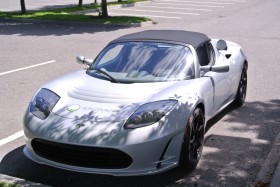
The Tesla roadster started the lifestyle attraction to EVS.
Jason a man about 40 was at the Voght street EV charging station last evening. Driving a 2015 used model of a Nissan Leaf he said it was his first time charging this recent purchase in Chilliwack. On the DC 500 Volt charger said that the charge would cost him 8 dollars.
Jason said that his car only had 3000 miles on it and was a lease back he paid 24,000 dollars for it and was not able to get a incentive payment as it was used. He was happy to have made it to Merritt from Hope on a charge from, saying his expected range is 125 KM an upgrade from the 1st generation Nissan leafs, giving a more comfortable trip over the mountains to Merritt.
He was continuing on to Kamloops were he expected to access another quick DC charger. He expressed happiness that there was money in the globe commitment to increase charging spots. ” It gave me the confidence to make the leap from may fossil fuel burning truck.”
We left Jason at a 97 % charge level with 12 minutes left to go in the 20 minute charge “It gos into trickle mode for the last bit so as not to be hard on the Battery. Jason also expressed confidence in the value of the warranty in the battery and ” I also have an extended one”.
Jason continued on with his female companion saying he also has BCAA. Jason seemed to be a well organized person. He expressed the hope and dream that one day Tesla cars would have an arrangement with Uber and driver less cars would be available on demand for a monthly fee similar to Net Flix.
He said that there is a book out on the life of Tesla motors driver Elon Musk, ” a reporter did it through interviews with a final approval before publication by Musk”.
Editors Note: there are many books on Musk available on Amazon, and !ndgo.
On this day: March 10th 1977
Rings on Uranus are observed.
On Saturday there was a sun dog reported in the morning rrsulting in a heavy frost on Sunday morning and a higher ceiling withj brighter sunny weather after a week of mostly cloudy and noted by locals as ” cold for the end of April.”
Sun dogs are commonly caused by the refraction of light from plate-shaped hexagonalice crystals either in high and cold cirrus or cirrostratus clouds or, during very cold weather, drifting in the air at low levels, in which case they are called diamond dust.[4] The crystals act as prisms, bending the light rays passing through them with a minimum deflection of 22°. As the crystals gently float downwards with their large hexagonal faces almost horizontal, sunlight is refracted horizontally, and sun dogs are seen to the left and right of the Sun. Larger plates wobble more, and thus produce taller sundogs.[5]
Sun dogs are red-colored at the side nearest the Sun; farther out the colors grade through oranges to blue. However, the colors overlap considerably and so are muted, never pure or saturated.[6] The colors of the sun dog finally merge into the white of the parhelic circle (if the latter is visible).[7]
The same plate shaped ice crystals that cause sun dogs are also responsible for the colourful circumzenithal arc, meaning that these two types of halo tend to co-occur.[8] The latter is often missed by viewers, however, since it is located more or less directly overhead. Another halo variety often seen together with sun dogs is the 22° halo, which forms a ring at roughly the same angular distance from the sun as the sun dogs, thus appearing to interconnect them. As the Sun rises higher, however, the rays passing through the plate crystals are increasingly skewed from the horizontal plane, causing their angle of deviation to increase and the sun dogs to move farther from the 22° halo, while staying at the same elevation.[9]
It is possible to predict the forms of sun dogs as would be seen on other planets and moons. Mars might have sun dogs formed by both water-ice and CO2-ice. On the giant gas planets — Jupiter, Saturn, Uranus and Neptune — other crystals form the clouds of ammonia, methane, and other substances that can produce halos with four or more sun dogs.[10] Source wikipedia
A lunar halo was seen in January and pictures of it are in the header video
( Best Regards) of this page.
On this day: April 28th2001
Dennis Tito becomes the world first space tourist.
Dr. Don McLeod local patron of the arts and owner of many ex public buildings including the old public library now the Culture club on Granite avenue is inviting people to come and hear his talk on what he got from a dinner with Stephen Hawkings.
The evening at the Culture Club starts at 7 PM on October 16th and will have a recounting of the conversation including black holes, creation of the universe discussed last month.
The Merritt Culture Club is the home of the local say so society ant is at 2058 Granite avenue in Merritt BC Canada.
Say So Expression Society: Come read poetry, sing a song, or speak your mind at the Say So Expression Society! $20 for a year’s membership. For more info call (250) 315-5673
Doctor Mcleods talk on thursday is a free, public service , talk FCFS.
Today in history: October 14th 1947
The speed of sound is broken for the first time by Chuck Yeager in the Bell X 1 rocket powered aircraft.
Royal Astronomical Society, Okanagan observatory. The Astronomical society has a free observatory open Friday’s on the way to Big White ski resort outside Kelowna. they report that they started with a long term lease for a dollar and have put 300 thousand more to convert the old gravel pit into a viewing platform. At a recent presentaion in Merritt, they showed an interested crowd the heavens from the local Public Library parking lot. The equipment they have on site is more powerful and they offer it free on Fridays. http://www.okanaganobservatory.ca/
The Okanagan Observatory hosts free public observing nights every Friday. The Okanagan Observatory is exactly 4 kms up Big White Rd from Hwy 33. That makes it only 35 kms from Rutland Rd. We will be pointing out the Milky Way and constellations with special astronomical laser pointers as we tour the night sky. Club members will have their telescopes on hand and be using the observatory 25 inch telescope to show off celestial wonders such as the Moon, planets, comets, dying stars, stellar nurseries, globular clusters, open clusters and galaxies.
Today in history: October 10th 1967 The outer space treaty come into effect after being signed by over 60 countries.



 Kevin Griffiths
 percypaschal
 The Proprietor Review