Category: Environment


British Columbia’s best : electric power

A pole waits to be installed at the edge of the Extra foods parking lot,Merritt BC to bring co-gen power to the Highland valley. Photo KDG

A pole waits to be installed at the edge of the Extra foods parking lot,Merritt BC to bring co-gen power to the Highland valley.
Photo KDG

The electric power generating ability of water power in British Columbia is owned by a non profit Crown Corporation BC Hydro Power and Authority. The corporation also owns and operates the transmission grid in the province. Lower rates to the consumer is the mandate of this non profit and it has had good success going back decades to the 1950s.The corporation was mandated and performed well with dams and treaty functions like the Columbia River deal with the Americans.
Merritt is in the middle of a co generation green energy project that is licensed by them and uses the transmission lines the they operate and maintain.A wood waste burner is being built to take 130 KV of power to the Highland Valley from the plant through a revamped Merritt substation that also gets power from other hydro sources.

On this day: February 4rth 2004
The social media site Facebook is created.

98.9 cents a liter

The psychological barrier of a dollar  a liter was broken  two weeks ago and the price of gas lingered at 99.9 for a time but now it has dropped another cent to 98.9 at he down town Petro Can.
The convenience store/gas station at the junction of highway 97c/8 and 5 also offers a loyalty program that gives 12 cents a liter discount to card holders. Shell and Chevron price are par with the Petro Can and there is no feeling of a price war.
Today in history: January 20th 1992

Inter air flight 148, an Airbus 320-111 crashes in Strasbourg France killing 87 people.


Three loads a day

A driver for Jim Lamb Contracting from Kamloops says that he is hauling logs from Peter Hope Lake to the local to Tolko’s mill here in Merritt.The routing is on highway 5A, Aka the old Kamloops road. He says he makes three loads a day and when asked about breakup something that could last three months at one time he said ” we don”t know”. The driver affirmed that he can not make money with the 70 % axle restriction on the highway. He makes three trips a day now from the popular recreational area north east of Merritt, just past stump lake :http://www.bcadventure.com/adventure/explore/high_country/merritt/peterhop.htm.
A colder winter may effect the length of restrictions on the highway when frost comes out of the ground.
Tolko industries is having a green wood waste burner built beside its operation in Merritt. The burner will co generate power into the BC Hydro grid.

Today in history:January 14th 2005
The Huygens probe lands on Saturn’s moon Titan.

TGIF 99.9

The price of regular gasoline here in Merritt has dropped to 99.9 cents per liter. This is the first time in a several years that the price has been under a dollar , once it dropped to 77.9 and briefly stayed before climbing back to the well over the dollar a liter level.

Today in History:January 9th 1839

The French Academy of Sciences announce the development of Daguerreotype  photography.

Icicles

They look innocuous but they can be deadly. Water dripping off a roof can produce icicles weighting multiple tens of pounds quickly, these items falling can do serious damage to a human.

Damage and injuries caused by icicles

Icicles can pose both safety and structural dangers.[5] Icicles that hang from an object may fall and cause injury and/or damage to whoever or whatever is below them. In addition, ice deposits can be heavy. If enough icicles form on an object, the weight of the ice can severely damage the structural integrity of the object and may cause the object to break.

The story of an English youth who was killed by a falling icicle in 1776 has been often recounted.[6][7][8][9]

Armstrong, the scientist from the National Snow and Ice Data Center, told a journalist, “Another twist is very large icicles falling from cliffs along highways hitting cars. Where I used to work doing avalanche hazard assessment and forecasting along U.S. Highway 550 in southwestern Colorado, icicles have fallen and destroyed passing cars.”[1]

In 2010, five people were killed and 150 injured by icicles in Saint Petersburg, Russia after a heavy snow that also caused apartment block roofs to collapse, as well as creating water damage to private homes and to the National Library of Russia.[10]

Kathleen F. Jones of the U.S. Army Cold Regions Research and Engineering Laboratory states, “The combination of the ice load and the wind on ice load can break wires, cross arms, and poles and/or other supporting structures. Damage associated with icicles on roofs may be to vehicles parked next to the overhang. Icicles on roofs are also often associated with ice dams that may cause water to infiltrate under the shingles with possible water damage to the house or building and its contents.”

Today in history: January 8th 1887
Wolf Mountain Montana sees the last battle between Crazy Horse and the United States Army

Norm Hansen a local naturalist is presenting at the societies January meeting.

Did you know that, a few thousand years ago as the last ice-age was coming to an end, the Nicola Valley was deep under a series of huge lakes. Massive chunks of ice blocked valleys to create these lakes, and as the ice melted the water rushing out of the lakes carved deep gorges. Today you can still see the lake shores of these ice dams, high in the hills around the Nicola Valley, and travel along the gorges that they carved out. Norm Hansen, a long-time forester from Merritt and NNS director, has for many years researched the history of these ice dams and their remnants and will share this amazing story with us.

Norm had a career in forestry including the private sector as a consultant after securing a degree from the university of British Columbia, Norm was raised in Golden BC in the Rocky Mountains and has a good appreciation of natural process and the wonder of the natural environment. Norms talk will be on January 15th at the NVIT college lecture theater, starting at 7:pm the society says that all are welcome,and membership or donation requested. Membership applications are available on the groups site:http://www.nicolanaturalists.ca/ The non-profit group takes responsibility for the winter bird count and are involved in scrutiny of frogs and other creatures here, they are members in good standing of the provincial naturalist organization.

Today in history: January 7th 1835 The HMS Beagle reaches the Chonos Archipelago  

$1.09.9 a liter

The Petro Canada is showing an offering of 1.09 a liter for regular gasoline at the pumping station at the junction of Highway 8 and 5A. There has been a dramatic drop in prices at the pumps in the last few weeks coming from mid $1.30 a liter to todays low. Petro Canada also offers a loyalty card program that gives you another 12 cents a liter making it possible to get regular gasoline at under the dollar a liter range. The CIBC is reporting that Canada has lost 5 billion in revenue in the recent drop in prices. We take that as lost revenue from exports. To balance the net benefit of lower gas prices to the consumer we must assume that a drop in price is a more broadly fare benefit to more people domestically then lost export revenue. Today in History: December 17th 1935 The DC-3 aircraft makes its first flight.  

Free trade has been a world opener for us in Canada however it has also brought with it a lot of unpleasentness that we Canadians could have avoided. If it is not possible to get cooperation then perhaps a tarriff regime is once again the best course for Canada. PR

Compare and contrast.

Prime Minister Stephen Harper, recently in the House of Commons:

“Frankly, Mr. Speaker, under the current circumstances of the oil and gas sector, it would be crazy, it would be crazy economic policy to do unilateral penalties on that sector. We’re clearly not going to do that,” Harper told the House as Conservative MPs roared their approval.
“In fact, nobody in the world is regulating their oil and gas sector. I’d be delighted if they did. Canada will be there with them.”

Jim Prentice, then federal minister of the environment, not quite five years ago:

“For those of you who doubt that the government of Canada lacks either the willingness or the authority to protect our national interests as a ‘clean energy superpower,’ think again,” he warned darkly. “We do and we will. And, in our efforts, we will expect and we will secure the co-operation of those private interests which are developing the oil sands. Consider it a responsibility that accompanies the right to develop these valuable Canadian resources.”

Back then, it was possible to believe the federal government would impose regulations on the oil and gas industries. The government certainly said it would, often enough. (Peter Kent in February, 2013: “We are now well into, and very close to finalizing, regulations for the oil and gas sector.”) But, as Chris Turner reminds us in his book The War on Science, Prentice quit as environment minister in November 2010, and the Harper government’s periodic attempts to demonstrate environmental virtue, even at some hypothetical cost to the resource sector, pretty much came to an end.

Of course, it can be hard to tell where the notion of oil and gas regulations ended. Prentice himself has been sounding much like Harper since he became premier of Alberta:

“Environmental performance is important, but so, too, is our industrial competitiveness . . . I think this low-price environment is a reminder . . . that we have to be careful laying on costs, including regulatory costs, on our industry, because we need to remain competitive.”

But is even that new? From my 2010 article, linked above:

“We will only adopt a cap-and-trade regime if the United States signals that it wants to do the same. Our position on harmonization applies equally to regulation. Canada can go down either road—cap and trade or regulation—but we will go down neither road alone.”

So the paper trail on the government’s oil and gas policy is a bit of a mess. The feds will only impose regulations in concert with the Americans? Well, there are two problems with that story. First, as Bruce Cheadle points out:

An Environment Canada briefing memo revealed last month by the Globe and Mail shows that the United States, in fact, placed what were called “significant” limits on its oil and gas sector in 2012.

“For oil and gas, recent air pollution regulations are expected to result in significant greenhouse-gas reduction co-benefits, comparable to the reductions that would result from the approach being developed for this sector in Canada,” states the June 2013 memo obtained by Greenpeace under an Access to Information request.


Mcleans
Yep!
Today in history: December 12 1911
Deli replaces Calcutta as the Capital of India.

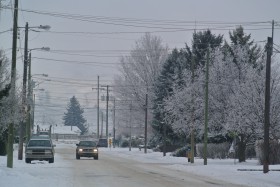
Hoar Frost

Hoar frost, Merritt BC  Photo KDG

Hoar frost, Merritt BC
Photo KDG

Hoar frost was caused by high humidity and freezing temperatures on Sunday. This gave the citizens of Merritt a wonderful display.

Frost is the term for several types of coatings or deposits of ice that may form in humid air in cold conditions, usually overnight. In temperate climates it most commonly appears as fragile white crystals or frozen dew drops near the ground, but in cold climates it occurs in a greater variety of forms.[1]

Frost is known to damage crops or reduce future crop yields, therefore farmers in those regions often invest substantial means to prevent its forming. source wikipedia.

Rain and above freezing weather came up from the west behind the humidity, however we were treated to a display on Sunday. The long rang forecast calls for snow before Christmas an moderate sub zero temperatures.

Today in history: December 11th 1972

The sixth and final landing on the moon is made by Apollo 17.

Twinning the line

The Pipeline filed their submission a year ago and our experience with the operators of the line over the last 60 years has been good , they have been presenting the economic benefits of the line. A copy of the filed submissions is in the quote below, remember these are construction jobs and benefits to most interested while there was a boom here with the first line it worked out to one permanent employee here then automation took that one away. Construction crews are often moved from project to project but the wise would lobby for lasting jobs by offering what it takes to attract either construction workers or maintenance people with amenities.

On December 16, 2013, Trans Mountain filed a Facilities Application for the Trans Mountain Expansion Project. This webpage is not intended as a substitute for the actual content of the submission. Volume 2 of the Application provides a full description of the Project. To view all eight volumes of the Application, click here. As the world’s third-largest oil producer, Canada benefits greatly from the export of national resources. Twinning the Trans Mountain Pipeline will increase Canada’s capacity to export these resources by facilitating the movement of oil to the West Coast for marine transport to market. It will further secure the supply of oil products to the Lower Mainland for use by BC’s residents and businesses. The project will also lead to new jobs in the short and long term, job-related training opportunities, and increases in taxes collected through all three levels of government. The $5.4 billion pipeline project will increase the value of Canadian oil by unlocking access to world markets. The combined minimum fiscal impact for construction and the first 20 years of expanded operations is $18.5 billion including federal, provincial and municipal tax payments that can be used for public services such as health care and education. British Columbia receives $2.1 billion; Alberta receives $9.6 billion, and the rest of Canada shares $6.8 billion. Municipal tax payments (not adjusted for inflation) total $922 million to BC and $124 million to Alberta over the first 20 years of expanded pipeline operations. Direct capital spending for the construction phase of the project includes $3.8 billion to British Columbia and $1.6 billion to Alberta. At the peak of construction, 4,500 people will be working on the pipeline expansion. The expansion will also create approximately 3,000 direct, indirect and induced jobs per year during operations. Overall the Project generates a minimum of 108,301 direct, indirect and induced person-years of employment during project development and operations. British Columbia’s share is 66,132 person-years including 35,864 during project development and 30,269 during operations. Alberta’s share is 24,926 person-years including 14,632 during project development and 10,293 during project operations.


Good luck to all that want a live an livelihood and peace to enjoy it.KDG
Today in History: December 9th 1962
The  Petrified Forest National Park is established in Arizona.

Over head work

Kevin Griffiths's avatarThe Proprietor Review

Helicopters doing work can be an overhead hazard File photo KDG Helicopters doing work can be an overhead hazard
File photo KDG

The 130 KV transmission line from Merritt to the Highland Valley is under way. A legal notice from BC Hydro put in the local paper says that helicopters will be stringing rope lines for the line for less then a week and be finished by mid December. Sources say that the line is a two wooded pole “H style” construction.

The project is slated to finish in 2015.

Today in History: December 2nd 1970, December 3rd 1997

View original post

Snow

Merritt Post Office Voght and Granite Photo: KDG

Merritt Post Office
Voght and Granite
Photo: KDG

There was an ocean effect snow fall(our term) here in Merritt last night, as witnessed by a confused seagull circling the Rail yard mall , we can only imagine that the megalomaniac looking down would think that his droppings were not usually that pronounced.
Seagulls come with air flows from the coast and signal wind and weather change. The forecast is now to turn colder after the next two days with over night lows going to well below freezing for Friday and Saturday. Hope the snow lasts.
http://www.weather.com/weather/5day/l/CAXX0830:1:CA
A tradition of Canadian Prime ministers is to go for a walk in the snow when contemplating calling an election.The PM still has that prerogative however elections have been put on a four year cycle with a semi fixed date. ( we don’t think it has anything to do with global warming) Jean Chretien went for a walk in the snow before risking trying for a 3rd term below. The fixed date is in May….

Today in history November 27th 2000

The liberal party of Canada wins a third term with an increase in members over the previous term.