You are presumed to be honest and responsible without evidence to the contrary beyond a reasonable doubt… on the balance of probablilties you are justified by 51 % likelyhood.
So, as covid was starting 2019 in the back and forth about pipeline expansion to the West Coast was still in flux but not so much. At that time executive of Canada bought back from the Americans so the pipeline so that they could double it twin it + bring the oil to the West Coast. To be shipped.
So the Americans in their hegemony, had strategically relied on this. The new administration that came in found out about Canada’s was short of the recommended goal for NATO. That the 2% of the GDP for the countries in that collective security agreement should be spent on defense and that would be at the availability of the resolution # 5 That gave us collective security.
The original trans mountain pipeline in the 1950s was done by an act of the parliament of Canada. It was paid for by taxpayers to some measure,this providing security to Canadians for energy. However, at some point the Americans acquired it + before the twinning the Trudeau government had to pay them and buy it from them in the billions of dollars.
Defense spending percent of GDP
There may have been bad faith there’s you know let’s let him build it and then we can get it away from them again. So at this point we’re considering another pipeline to the coast. We have brought our defense spending up to 5%. So we are not as prone to give “Friend Discounts” now..
The Americans all through their hegemony hovered around 3.6% of their “world’s biggest GDP”. They paid out produceing nearly 800 military bases around the world.
Let’s play and not just get played.
Because Americans will:
Plays to make:
Sell them stock
Short ours..
Create a digital reserve fund as the only pay vehicle for oil.
Accuse the accuser.
Get a security discount for our role.
Consolidation
Play sectors against each other…
Offer governorships to make rivals.
Start wars to make it National security for us to want…
The point is that we are here to heal . The finger pointing is probably not productive. However, discovery is of use and here is what was determined from the Congressional hearings on Dr. Fauci’s involvement in covid-19.
The Proximal Origin of SARS-CoV-2
The congressional hearings involving Dr. Anthony Fauci—most notably the marquee hearing before the House Select Subcommittee on the Coronavirus Pandemic in June 2024 (as well as prior tense exchanges with:
COVID-19
Expansion runs the course with Covid 19
Editor’s note: Kudos to The Canadian people, who persevered and prospered and looked ahead. In particular, we think of the Trans mountain expansion that gave an industrial opportunity through covid as well as societal value to those that took up that row through two provinces and a nation. Their hope generation was inspiring.
The congressional hearings involving Dr. Anthony Fauci—most notably the marquee hearing before the House Select Subcommittee on the Coronavirus Pandemic in June 2024 (as well as prior tense exchanges with lawmakers like Sen. Rand Paul)—were among the most fiercely partisan proceedings on Capitol Hill. Below is a breakdown of what he was accused of, how the hearings played out, and what the evidence actually established regarding claims of wrongdoing.
1. What Were the Main Accusations?
House Republicans and conservative critics leveled several key accusations against Dr. Fauci: * Funding “Gain-of-Function” Research in Wuhan: Critics accused the National Institute of Allergy and Infectious Diseases (NIAID), under Fauci’s direction, of funding dangerous “gain-of-function” research at the Wuhan Institute of Virology (WIV) through grants to EcoHealth Alliance—alleging this research created SARS-CoV-2. * Suppressing the “Lab Leak” Theory: Accusations were made that Fauci orchestrated a cover-up to discredit the lab-leak hypothesis, bribing or pressuring scientists into publishing the March 2020 paper “The Proximal Origin of SARS-CoV-2” to promote a natural origin narrative. * Misleading Congress: Lawmakers accused Fauci of lying under oath when he testified in 2021 that the NIH did not fund gain-of-function research at the Wuhan lab. * Promoting “Unscientific” Guidelines & Mandates: Critics targeted public health guidance—such as six-foot social distancing rules, mask mandates, and vaccine requirements—claiming they lacked rigorous scientific backing and harmed businesses, schools, and personal freedoms. * FOIA Evasion / Misconduct by Staff: Subpoenaed emails showed a senior advisor to Fauci, Dr. David Morens, explicitly bragged about using personal email accounts and deleting records to evade Freedom of Information Act (FOIA) requests regarding the origins of COVID-19.
2. Synopsis of How the Hearing Went
The June 2024 public hearing was marked by deep political polarization: * Republican Interrogations: GOP members subjected Fauci to aggressive questioning. Rep. Marjorie Taylor Greene refused to address him as “Doctor,” called for him to be prosecuted for “crimes against humanity,” and caused a brief breakdown in committee decorum. Republican lawmakers argued that Fauci operated with extreme hubris and presided over destructive pandemic policies. * Democratic Defense: Democrats emphasized that Fauci had served under seven presidents, saved millions of lives through HIV/AIDS and COVID-19 research, and had become a scapegoat for partisan political attacks. They highlighted that no smoking gun had been produced linking NIH grants to the pandemic’s origin. * Fauci’s Testimony: Fauci defended his record, strongly rejecting claims that he covered up a potential lab leak. He stated that he kept an “open mind” regarding the virus’s origins, but emphasized that the specific bat coronaviruses studied under the NIH grant were genetically impossible to have been turned into SARS-CoV-2. 3. Did He Do Anything Wrong? Findings & Reality Check Investigations and testimony established the following facts regarding allegations against Fauci: ❌ Illegal Acts or Personal Corruption * No evidence of illegal conduct by Dr. Fauci: No congressional committee, federal agency, or law enforcement body found evidence that Dr. Fauci committed a crime, personally profited, or committed scientific fraud. * FOIA/Email claims: Fauci testified under oath that he never used private email for official government business. Investigators found no emails showing Fauci attempted to evade FOIA laws. ⚠️ Real Misconduct by a Senior Advisor (Dr. David Morens) * What was wrong: Subpoenaed emails revealed that Dr. David Morens (a senior advisor to Fauci) engaged in clear misconduct—using personal email, attempting to delete records to avoid FOIA, and sharing non-public information with EcoHealth Alliance. * Fauci’s response: Fauci explicitly condemned Morens’ actions during the hearing, testifying that Morens violated NIH policy and engaged in behavior that was “wrong and inappropriate.” 🔍 The “Gain-of-Function” & Definition Dispute * The debate: The disagreement over whether the NIH funded “gain-of-function” research comes down to definitions. * Fauci pointed to the strict federal regulatory definition (P3CO framework) in place at the time, under which the research did not qualify as gain-of-function. * Critics and some NIH officials argued that under a broader definition (enhancing a virus’s transmissibility or lethality), the research at Wuhan fit the description. * Crucial distinction: Regardless of definitions, virologists confirm that the viruses researched under the NIH grant were phylogenetically distinct from SARS-CoV-2—meaning they could not have mutated into or caused COVID-19. 📉 Public Health Guidance Criticisms * Social Distancing / Masks: Fauci acknowledged during interviews that early guidance (like 6-foot social distancing) was based on initial rule-of-thumb estimates from the CDC rather than clinical trial data. * While critics viewed this as evidence of arbitrary control, supporters and public health experts framed it as standard practice when responding to a novel virus with rapidly evolving information.
If questions weren’t challenging there would be no reason for the 5th amendment.
Editor’s note:
Not usually a dreamer but:
I had a strange dream the other night and I saw Dr. Fauci at an airport gate and somehow I was going in and he was going out. Sorry was the other way around. You got to get this right?
Then I said hi to him and he seemed defensive and I told him I was aware of the passing of the longest living iron lung treated person. This girl at 5 years old contracted polio wound up paralyzed and spent 73 of 78 years of life paralyzed.
She died July 26th. 2026, her name was Martha Lillard.
I said I was vaccinated about her age and still have a scar on my arm.
In my dream it seemed he smiled when I said thanks for the vaccines. Being a Canadian he probably had no responsibility for my vaccines but he didn’t know that.
Personally, I took all the vaccinations in that time frame. I took some heat from security people that were against vaccinations or at least challenging me about vaccinations when I went in for my first one at the arena.
When quarantines ended. I went out the first night to a singing thing, that was Friday by Sunday I felt sick. I had gotten some kits for testing and I went home or I was home and I tested, and I was positive. I’m thankful that I had all the vaccinations. I tested a couple times during the self isolation all positive.
Five days and feeling better, I could come out of self-isolation. And I did. So that was the only time that I got it during the whole pandemic! And I’m thankful for the time I have. Never tested again never tested negative.
Legitimate warnings rejected at the peril of all involved.
Cassandra a Greek goddess made a prophetess by Apollo.
Burn it father, warnings about the “Trojan Horse”
Cassandra Ignored
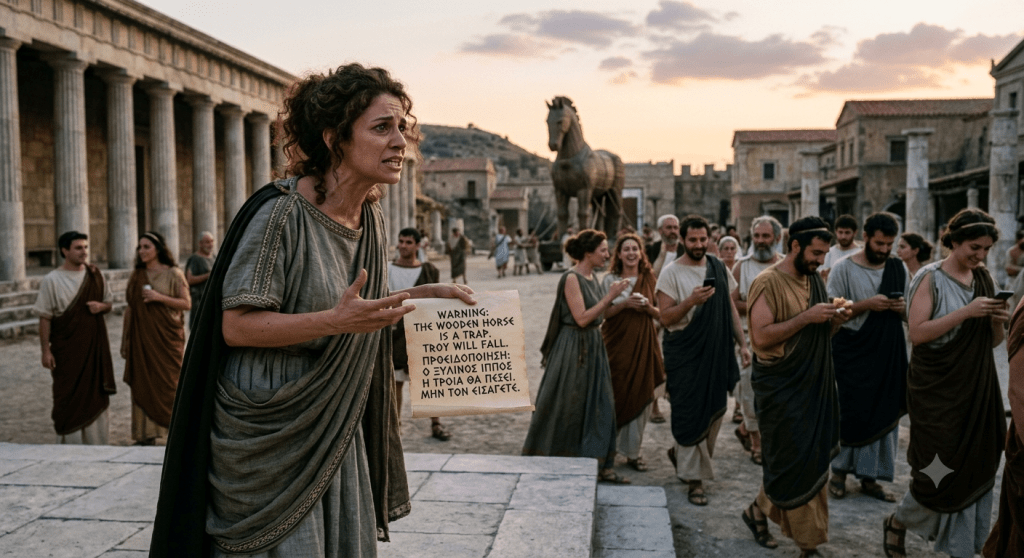
The tragic consequences of ignoring Cassandra are powerfully illustrated by the scene in image_0.png. Having been granted the power of prophecy by the god Apollo, but later cursed by him to never be believed after rejecting him, Cassandra became a tragic figure of ignored wisdom. Her desperate and specific warning that the Greek’s wooden horse was a ruse to destroy Troy was utterly disregarded by the very people it was intended to save, who interpreted her pleas as madness. As seen in the image, the Trojans are caught up in the relief of winning the war, checking their modern mobile devices, and celebrating, completely missing her critical warning and even holding the symbol of their impending doom in the background. The tragic irony lies in the fact that her prediction was absolute and her plea accurate, yet the curse ensured that her voice remained empty. Because the Trojans dismissed her prophecy as the ramblings of a crazed woman, they invited their own destruction, and Cassandra was forced to watch, in agonizing foresight, as the very people she tried to protect were slaughtered and their city was burned to the ground.
So us humans persist regardless of warnings, The point is we’re all still here.
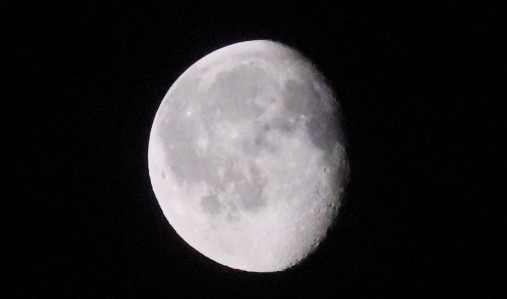
A cooling by a cold front bringing wind gave a clear sky and a view of the moon waning 😞 in the eastern sky as it moves west to a new moon on August 12th at 10:36 AM.
Merritts overnight low is forecast to go to single digit into August 3rd… -(8)
Condolances to Spokane on their loss…
Update
Merritt at mid-afternoon has no alerts in effect, surrounding hills have a din of smoke. While most community’s going north west of here remain with yellow stage one air quality warnings.
The Genesis of this may have come from character from comic books nearly a century ago, he was called Buck Rogers, January 7th 2029 first comic strip published.
So, the smoke tariff is a thing of the past, as we go into August 2026. But here’s an idea, create a narrative in your garden over August before you harvest in September with garden totems. Tell the the story in gli🌨️phs of nick nacs and surviving images that may have perished except for your pluck and presence.
So, enduring…
Happy day on your way…
Editor’s: Note Smoke is back going into the weekend…













 Kevin Griffiths
 percypaschal
